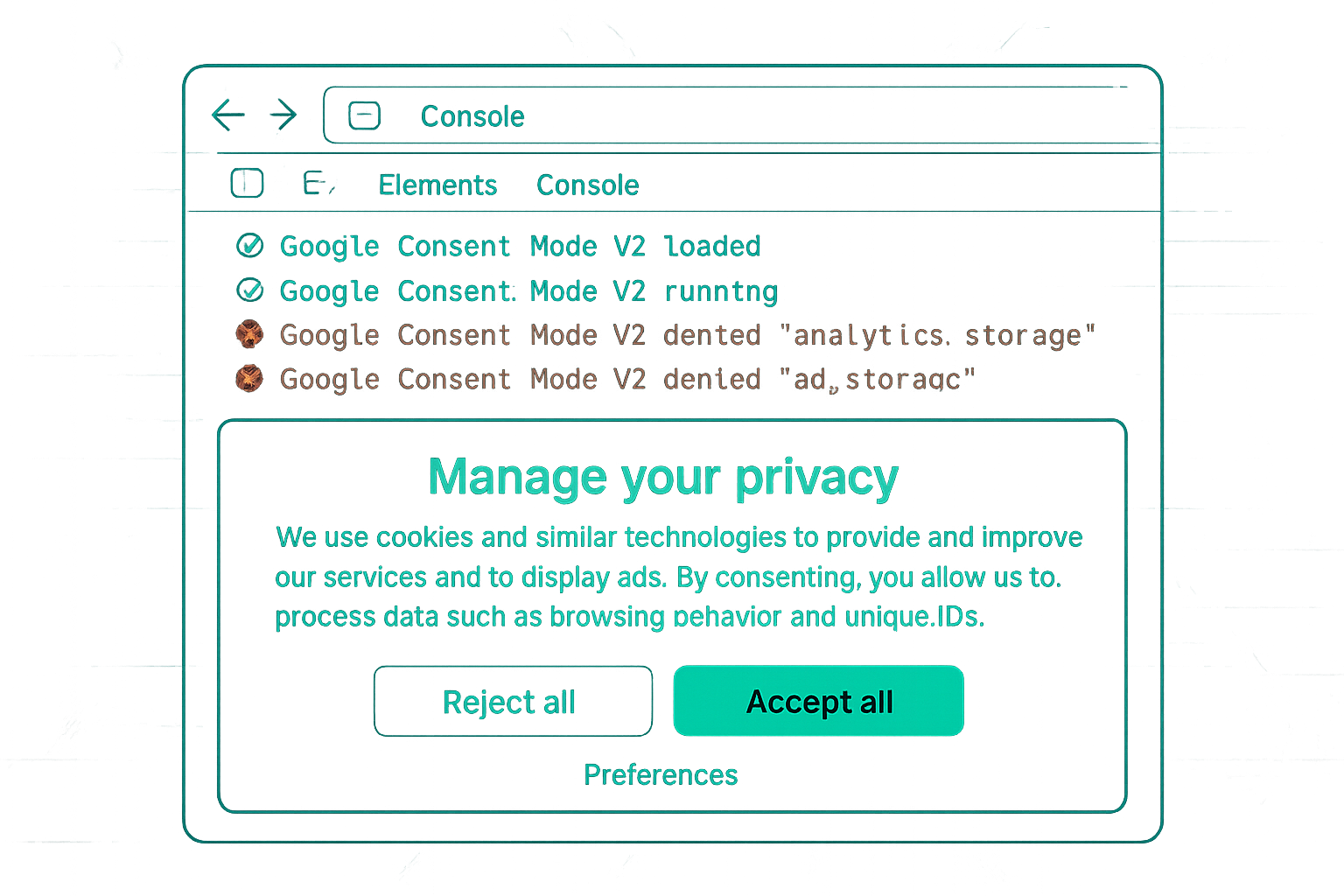
Why Consent Mode Matters for Google Ads
Google Ads conversion tracking in the EEA requires Consent Mode v2 compliance from March 2024. Without it, Google restricts the use of cookies for ad measurement for EEA users — meaning conversions from EEA users may not be recorded and Smart Bidding cannot optimise on those conversions. This directly affects your campaign performance in European markets.
How Consent Mode Affects Conversion Counting
With Consent Mode v2 implemented:
Consenting users (ad_storage=granted + ad_user_data=granted): Google Ads tracks conversions normally with full cookie-based attribution. The gclid parameter links the click to the conversion. Enhanced Conversions can send hashed email for additional matching.
Non-consenting users (ad_storage=denied): Google Ads cannot use cookies, cannot read gclid, cannot link a conversion to a specific click. The cookieless ping from the conversion page contributes to modelling only. These conversions are never directly attributed — they appear in Google Ads as modelled conversions in aggregate.
Smart Bidding with Consent Mode
Smart Bidding (Target CPA, Target ROAS, Maximise Conversions) uses all conversion signals including modelled conversions. When Consent Mode is implemented correctly:
- Smart Bidding receives the observed conversions from consenting users
- Smart Bidding also receives modelled conversion estimates for the non-consenting portion
- The algorithm bids based on the combined signal, which is more complete than observed-only data
This is why correct Consent Mode v2 implementation can actually improve Smart Bidding performance versus having no Consent Mode — the modelling fills the gap versus having a broken signal.
The New Consent Types for Advertising
Consent Mode v2's new consent types have specific advertising implications:
- ad_user_data=denied: Google cannot use the user's data for advertising measurement purposes. Even if ad_storage is granted, ad measurement is restricted without ad_user_data consent.
- ad_personalization=denied: Data cannot be used for remarketing and audience list building. Users who deny this cannot be added to remarketing audiences.
Remarketing Audience Impact
Users who deny ad_personalization consent cannot be added to Google Ads remarketing audiences. Your audience membership counts will decrease proportionally to the number of users declining this consent type. In GDPR markets, this is legally required — these users must not be retargeted without consent.
Summary
Consent Mode v2 in Google Ads means: consenting users are tracked normally with full attribution, non-consenting users contribute to modelling only (no direct attribution), Smart Bidding uses both observed and modelled conversions for optimisation, remarketing audiences exclude non-consenting users. Correct implementation is required for EEA compliance and may improve Smart Bidding versus the alternative of broken/non-compliant tracking.
See our Consent Mode v2 Implementation service for advertising tracking setup.
Need Consent Mode v2 for your Google Ads campaigns? Contact Adslytics.
Need expert tracking setup?
Our Google Tag Manager experts have delivered 500+ tracking setups with a 98% success rate.
Get a Free Consultation →