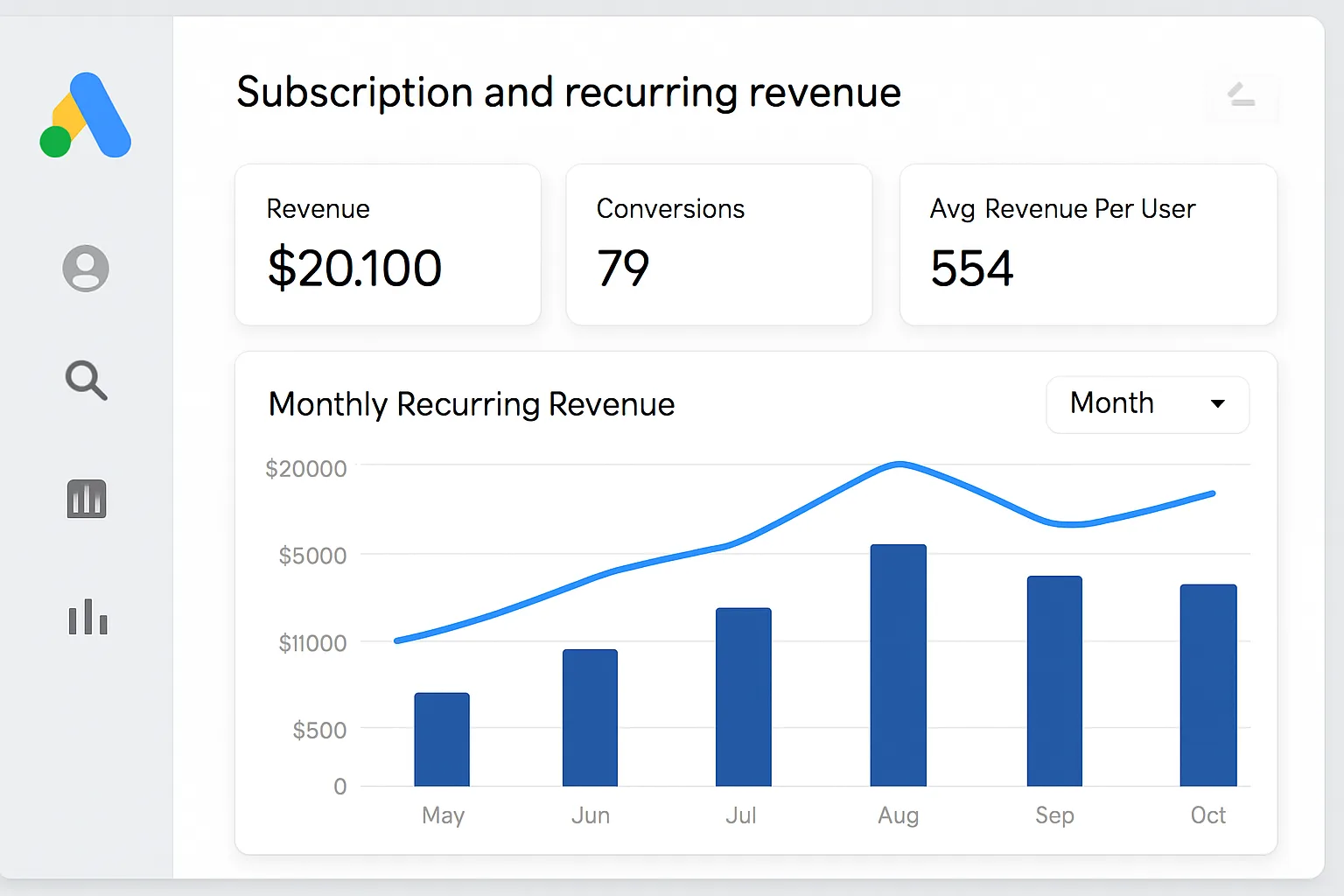
The Subscription Tracking Problem
Standard Google Ads conversion tracking is built around single-event conversions: a user clicks an ad, completes an action, and a conversion is recorded. For subscription businesses, this model is fundamentally incomplete. The real value of a subscriber lies in months or years of recurring payments — not just the initial sign-up.
Without recurring revenue signals, Smart Bidding optimises for sign-up volume, not customer value. It might fill your funnel with free trial users who churn after one month while underspending on channels that attract three-year subscribers.
This guide covers how to build a subscription-aware Google Ads conversion tracking setup.
Step 1: Track the Initial Conversion with Accurate Value
The first conversion event should be the paid subscription start (not a free trial sign-up, unless your trial converts at a very high rate). Assign the actual first payment value — or a predicted customer lifetime value — as the conversion value.
Two approaches for conversion value assignment:
- First payment value: simple and accurate. Set the conversion value to the actual first month or year payment. Smart Bidding can then optimise for ROAS based on real revenue.
- Predicted LTV: assign a higher conversion value based on your average subscriber lifetime value (e.g. if average subscribers stay 18 months at £30/month, assign a value of £540). This requires knowing your LTV data and updating it as it evolves. Smart Bidding will bid higher for acquisitions when it knows the LTV is high.
Step 2: Send Renewal Events as Offline Conversions
Each recurring payment is a revenue event attributable to the original Google Ads click. By uploading monthly renewal payments as offline conversions, you give Smart Bidding an accurate picture of total customer revenue per ad click — not just first payment.
Process:
- When a user signs up via Google Ads, capture and store their GCLID alongside their subscription record
- Each month when their subscription renews, upload the renewal as an offline conversion to Google Ads, referencing the original GCLID and the renewal payment amount
- Continue for the life of the subscription
Google Ads accepts offline conversion uploads with past conversion timestamps up to 90 days old — so monthly renewals are well within the upload window.
Step 3: Separate New Subscriptions from Renewals
Create distinct conversion actions for:
- New subscription (primary conversion, online)
- Renewal month 1 (secondary/offline)
- Renewal month 2+ (secondary/offline)
- Annual renewal (secondary/offline)
- Churn / cancellation (tracked but as negative conversion value)
Keeping them separate lets you see which campaigns acquire long-term subscribers vs churners.
Step 4: Use New Customer Acquisition Goals
For subscription businesses with an existing subscriber base, activate Google Ads New Customer Acquisition goals. This tells Smart Bidding to prioritise acquiring new subscribers over re-engaging lapsed ones, and to bid accordingly — especially important as your existing subscriber list grows.
Step 5: Churn-Adjusted LTV Bidding
Once you have 6+ months of subscriber data tied to GCLID, you can calculate the actual LTV of subscribers acquired from each campaign and keyword. Use this data to set your Target ROAS — campaigns acquiring subscribers with 24-month average LTV should have a different ROAS target than those acquiring 3-month subscribers.
Pass this insight to Smart Bidding via differential conversion values assigned at the campaign level, or by adjusting campaign targets based on channel-specific LTV data.
Summary
Subscription tracking in Google Ads is a multi-step process: accurate first-payment conversion, ongoing renewal offline uploads, and LTV-informed ROAS targets. The businesses that implement this see significantly better Smart Bidding performance — because the algorithm is optimising for subscriber revenue rather than sign-up volume.
See our Google Ads Conversion Tracking service for subscription-specific setup.
Ready to track subscription revenue accurately? Contact Adslytics.
Need expert tracking setup?
Our Google Tag Manager experts have delivered 500+ tracking setups with a 98% success rate.
Get a Free Consultation →