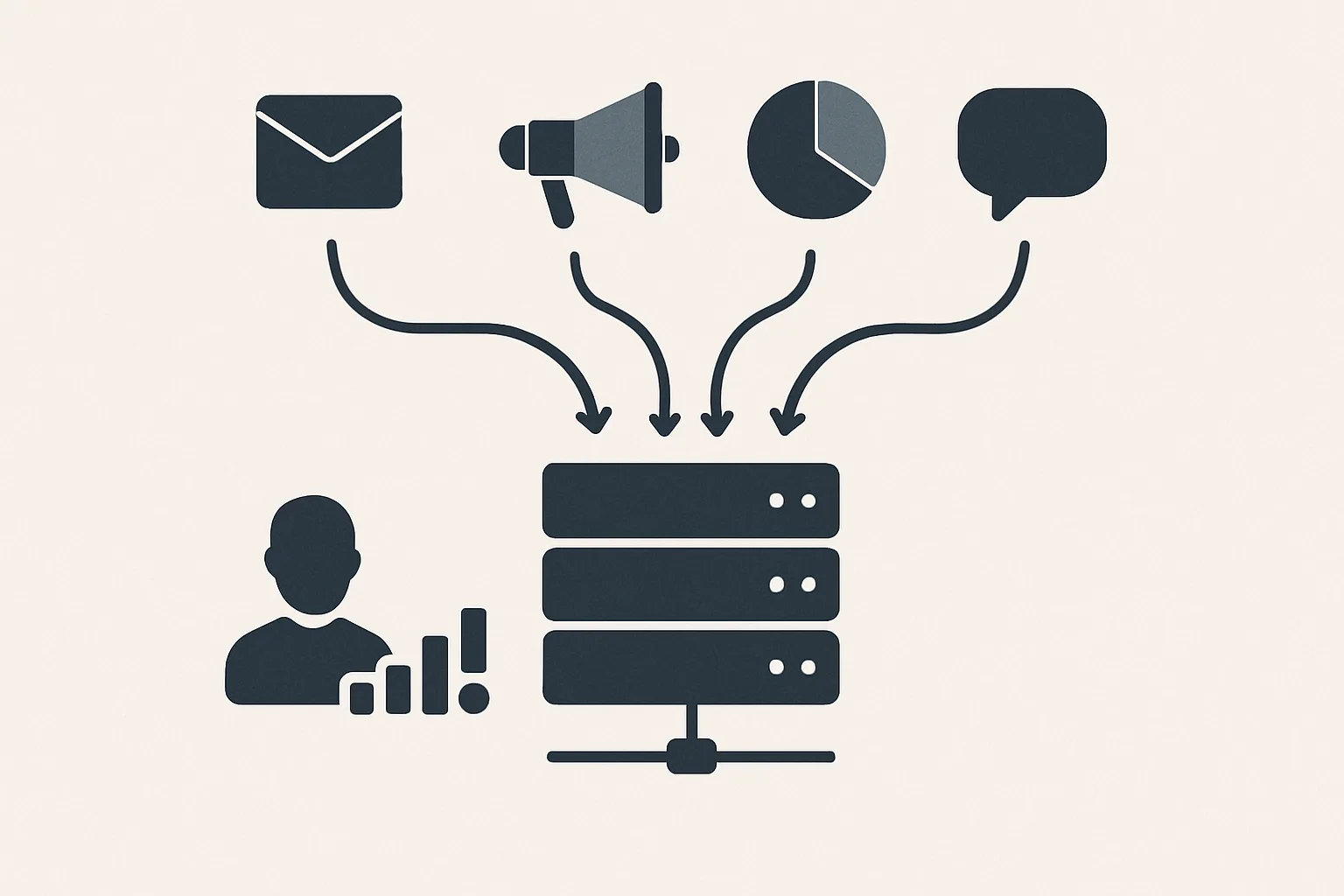
The Problem: Tag Proliferation
The typical marketing stack has 20–50 tags firing on every page: Google Analytics, Google Ads conversion tag, Facebook Pixel, TikTok Pixel, LinkedIn Insight Tag, Hotjar, Intercom, Drift, Klaviyo, and dozens more. Each vendor has their own JavaScript library, their own event format, and their own integration that needs maintenance.
The problems this creates:
- Performance: Every additional tag adds page load time and degrades user experience
- Maintenance burden: When you rename an event or change your data structure, you update it in every destination separately
- Data inconsistency: Each tag fires its own events — subtle differences in timing and logic create data discrepancies between platforms
- Privacy risk: Every third-party script has access to your page data and can drop its own cookies
A CDP solves this with a fundamentally different architecture. Our CDP implementation team regularly replaces 30+ tags with a single collection layer.
The CDP Architecture: Collect Once, Deliver Everywhere
With a CDP, you fire one event per action — the CDP's own event call. The CDP then fans that data out to every destination in real-time:
User action → CDP.track('Purchase Completed', {orderId, revenue, items})
→ Google Analytics 4
→ Facebook Conversion API
→ Google Ads Conversion
→ Klaviyo Email Purchase Event
→ Data Warehouse
→ Salesforce CRM
All destinations receive the same data from the same event, fired once. No more managing separate tag implementations for each destination.
What Changes in Your GTM Setup
With a CDP, GTM becomes much simpler. Instead of managing 40 tags for different vendors, you manage:
- One CDP initialization tag (Segment Analytics.js or similar)
- Event tracking calls that push data to the CDP
GTM still plays a role — it's often used to fire CDP events based on page interactions (button clicks, form submissions, scroll depth). But the complexity of managing individual vendor pixels disappears. The data layer becomes even more important as the single source of structured event data that feeds the CDP.
Server-Side Destinations: Better Data Quality
A major benefit of CDPs is that many destinations support server-side delivery. Instead of the user's browser sending data to Facebook or Google Ads, the CDP server sends the data directly.
This is functionally similar to server-side tracking — the destination receives data regardless of whether the user has an ad blocker or browser privacy settings that would block client-side tags. For Google Ads conversion tracking and Facebook CAPI, CDP server-side delivery significantly improves signal quality.
Maintaining the Collection Layer
The long-term benefit of a single collection layer is maintenance simplicity. When your product team launches a new feature and wants to track it:
- Without CDP: Add tracking to GA4, Facebook Pixel, LinkedIn, TikTok, and three internal systems separately
- With CDP: Add one CDP track call. All destinations receive the event automatically.
When you add a new marketing tool:
- Without CDP: Implement and maintain their specific SDK or tag
- With CDP: Enable their destination connector in the CDP dashboard. Data starts flowing immediately.
The Foundation Still Matters
A CDP simplifies your collection layer — but it doesn't substitute for good data collection practices. You still need:
- A well-designed event schema (consistent naming, rich properties)
- Proper identity calls (identifying users when they log in or sign up)
- A clean data layer feeding events with accurate property values
If your upstream tracking is poor, the CDP will distribute that poor data to every destination simultaneously. Our implementation team always begins with a tracking audit before CDP deployment. Contact us to assess your current tracking architecture and plan your CDP rollout.
Need expert tracking setup?
Our Google Tag Manager experts have delivered 500+ tracking setups with a 98% success rate.
Get a Free Consultation →