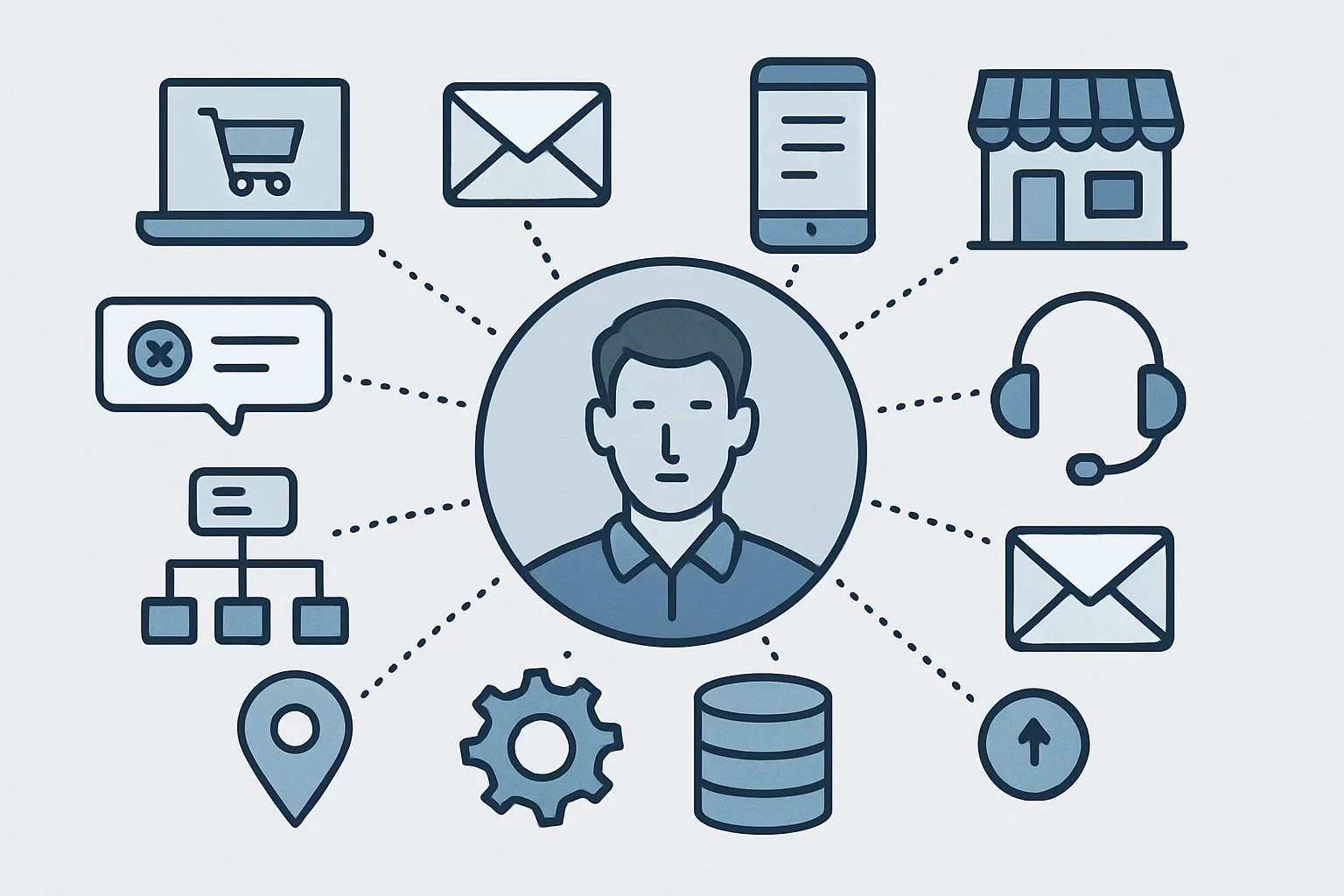
The Single Customer View: Promise vs Reality
Every CDP vendor promises a "Single Customer View" (SCV) — one unified record per customer containing all their interactions across all channels. It's the most cited CDP value proposition. It's also one of the most overestimated in terms of how quickly it can be achieved.
A true SCV requires not just technology but also data governance, engineering work, and organizational alignment that takes months to build properly. Our CDP implementation team helps clients set realistic expectations and build toward a genuine SCV.
What a True Single Customer View Contains
A complete SCV for a typical B2C business includes:
- Identity data: Email, phone, name, address, account IDs across all systems
- Behavioral data: All website and app interactions, pages visited, features used
- Transactional data: All purchases, returns, subscriptions, payment history
- Marketing engagement: Email opens/clicks, ad impressions and clicks, push notification responses
- Service history: Support tickets, chat conversations, returns, complaints
- Preferences: Communication preferences, consent status, self-declared interests
- Derived metrics: LTV, engagement score, churn probability, segment memberships
Most organizations have this data — it's distributed across 10+ systems that don't talk to each other.
The Identity Resolution Challenge
The biggest technical barrier to SCV is connecting the same person across multiple systems with different identifiers:
- Website: anonymous cookie ID → authenticated user ID
- CRM: Salesforce contact ID
- Email platform: subscriber ID
- Payment processor: Stripe customer ID
- Support platform: Zendesk user ID
Linking these requires a shared identifier (typically email address) that appears in multiple systems. Where no shared identifier exists, probabilistic matching or manual matching is required.
CDPs automate this through identity resolution — but only for the data they receive. Systems that aren't integrated into the CDP still create fragmented profiles.
A Realistic SCV Roadmap
Phase 1: Behavioral SCV (Weeks 1–8)
Connect web + app behavioral tracking via CDP. Build profiles that unify anonymous sessions with known users after login/registration. This alone is transformative for marketing — you can now track the full pre-purchase journey.
Phase 2: Transactional Integration (Months 2–4)
Connect purchase/subscription data from your backend via server-side events. Now profiles include transaction history alongside behavioral data.
Phase 3: CRM and Marketing Platform Integration (Months 3–6)
Bidirectional sync between CDP and CRM — CDP pushes behavioral data into CRM, CRM pushes relationship data back into CDP. Email platform integration adds engagement history.
Phase 4: Support and Offline Data (Months 6–12)
Support ticket data, in-store purchase data, call center data. These require custom integrations and often manual data matching work. This is where most SCV projects stall — the data exists but getting it into a consistent format is significant engineering work.
What Most Organizations Actually Need
A "complete" SCV across all touchpoints isn't necessary for most use cases. A 70% SCV — behavioral + transactional + CRM — unlocks most high-value personalization and activation scenarios at a fraction of the cost and effort of a perfect SCV.
Define your highest-value use cases first. Build only the integrations those use cases require. The perfect SCV that takes 18 months generates no ROI during those 18 months. A 70% SCV that takes 3 months generates ROI immediately.
Our CDP team uses this pragmatic approach. Contact us to scope a Single Customer View initiative that prioritizes ROI over completeness.
Need expert tracking setup?
Our Google Tag Manager experts have delivered 500+ tracking setups with a 98% success rate.
Get a Free Consultation →