
Client Overview
Disiplinasyon.com runs paid social campaigns (primarily Instagram) driving traffic into GoHighLevel-hosted funnels, seminar registration forms, and one-step order forms for digital products. Their lead-to-purchase journey is fully managed inside GoHighLevel, from initial form submission through payment.
The Challenge
The client's Meta ad account was underperforming relative to actual sales volume. Investigation showed a core structural problem: purchase events were never reaching Meta at all. GoHighLevel handles payments internally and has no native, reliable mechanism for forwarding conversion data to Meta's Conversions API with full attribution fidelity.
This created two compounding issues:
- Invisible conversions. Meta's ad algorithm was optimizing blind, with no purchase signal to learn from, actively working against the client's own ad spend efficiency.
- iOS/browser tracking decay. Even where a browser-side Pixel existed, iOS 14.5+ and standard browser tracking prevention were silently dropping a significant share of events before they ever reached Meta.
Our Approach
We designed a direct pipeline: GoHighLevel → Google Tag Manager Server Container → Meta Conversions API, bypassing the browser entirely for the final delivery step. This meant purchases would be reported reliably regardless of ad blockers, cookie restrictions, or in-app browser quirks — a meaningful factor given the client's traffic comes heavily from Instagram's in-app browser.
Rather than relying on GoHighLevel's limited native integrations, we built a custom receiving endpoint inside the client's existing server-side GTM container, giving us full control over data shape, field mapping, and downstream routing — with room to extend to Google Ads or GA4 later without re-architecting anything.
Technical Implementation
1. Custom GTM Server Client
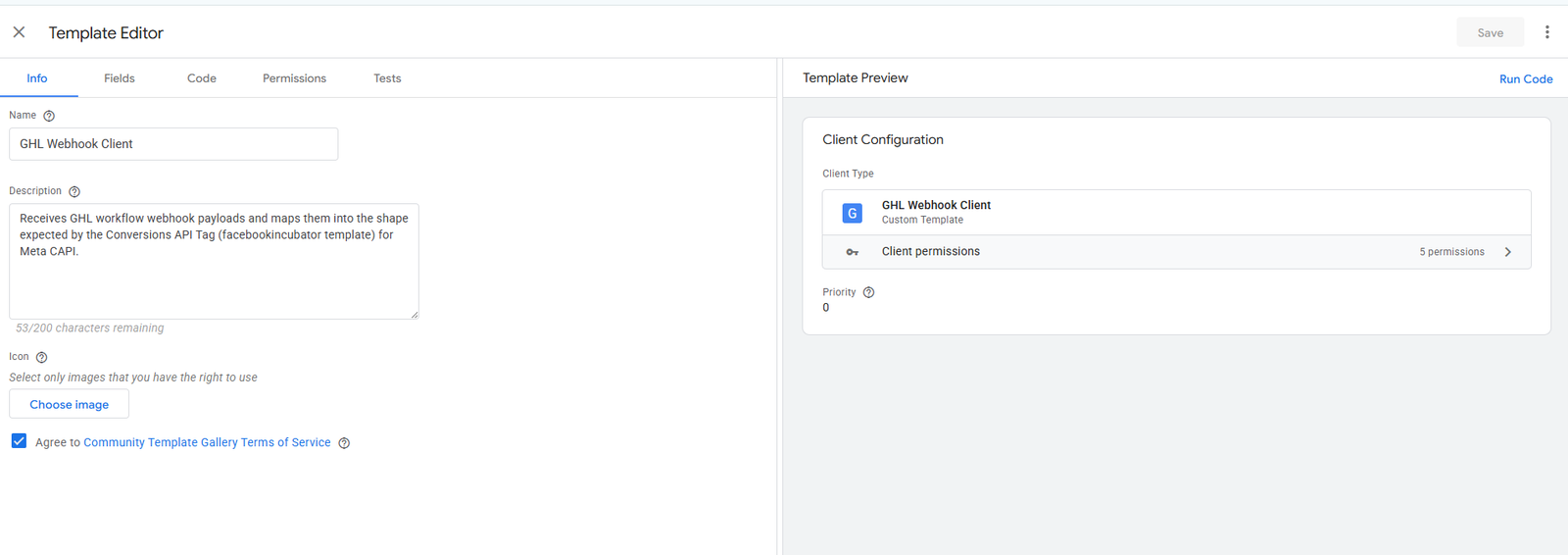
We built a bespoke Client Template inside the server container — a purpose-built receiver that listens on a dedicated endpoint (/ghl-events), parses GoHighLevel's native webhook payload, and pushes it into the container as a structured event, with no third-party middleware required.
2. GoHighLevel Workflow Configuration
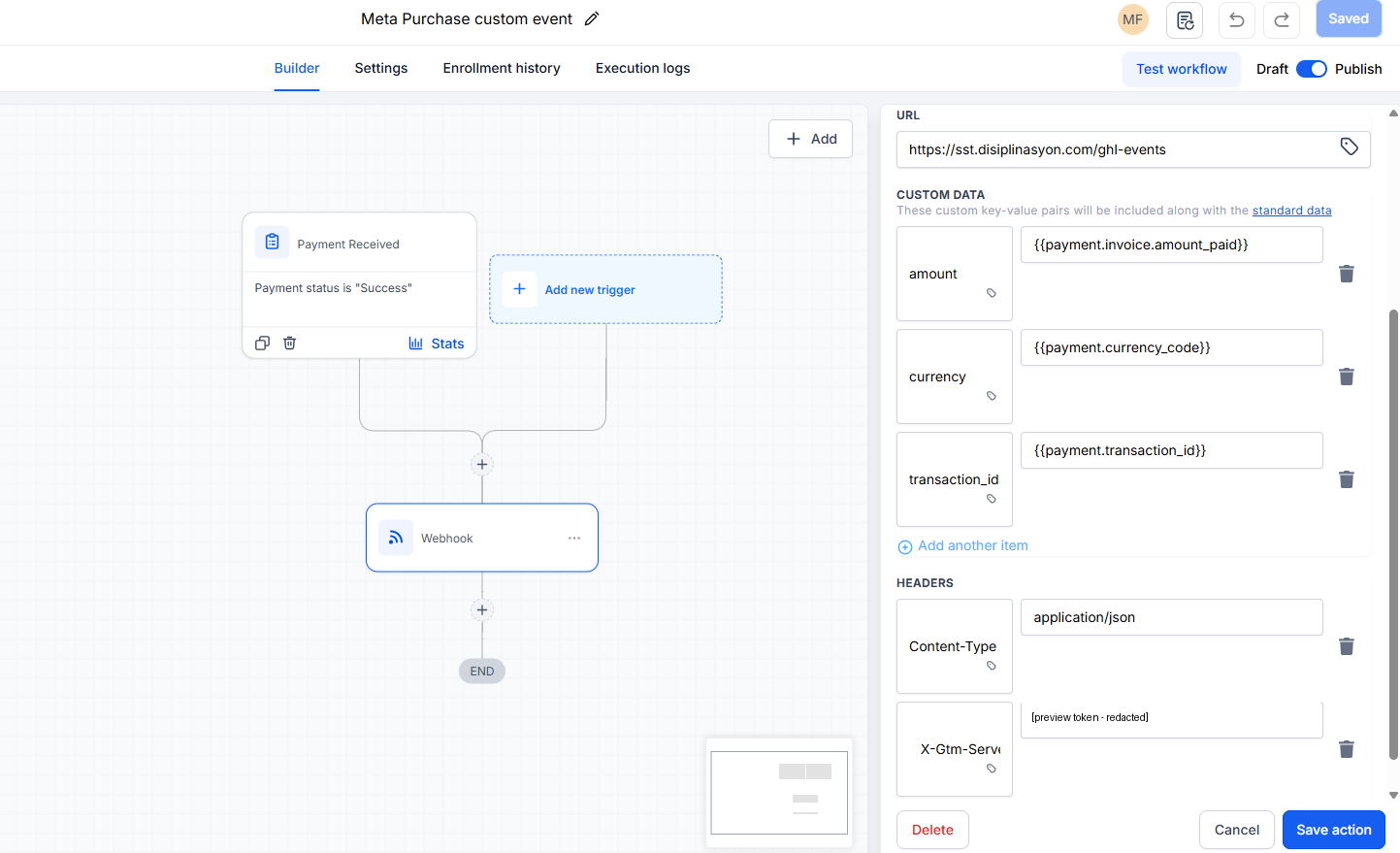
We configured a "Payment Received" workflow inside GoHighLevel — filtered to only fire on a successful payment status — to send a webhook directly to the server container the instant a transaction completes, carrying the full contact, payment, and attribution payload GoHighLevel generates automatically.
3. Endpoint Validation
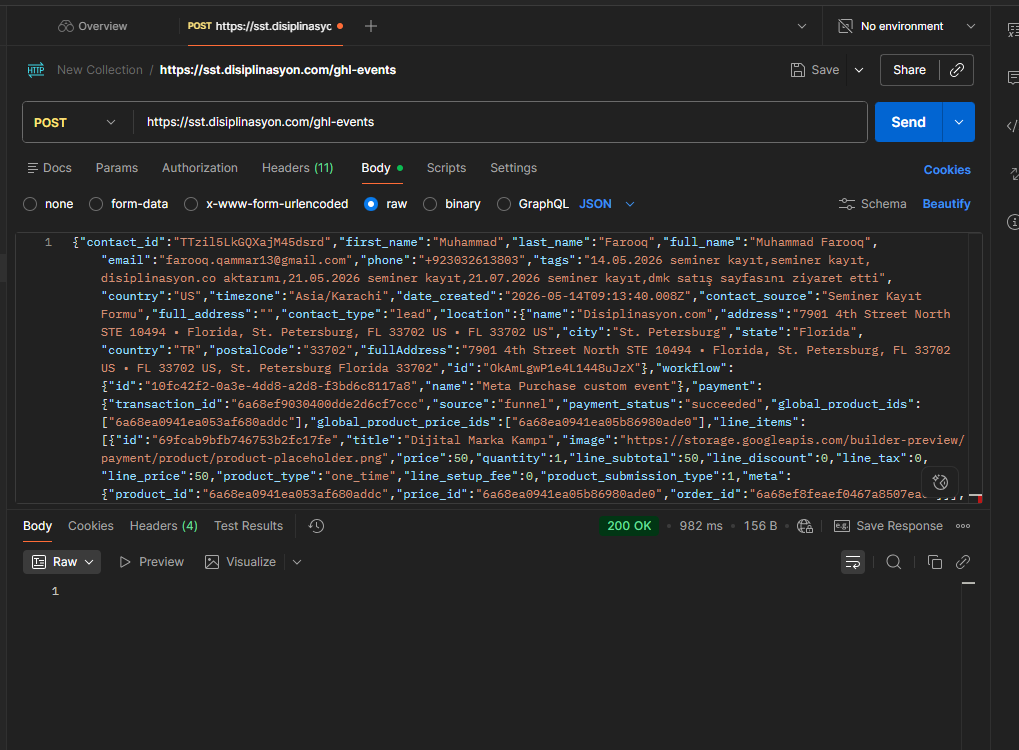
Before connecting the live workflow, we validated the receiving endpoint directly with real payload structures to confirm the server container parsed and responded correctly under controlled conditions.
4. Meta CAPI Field Mapping
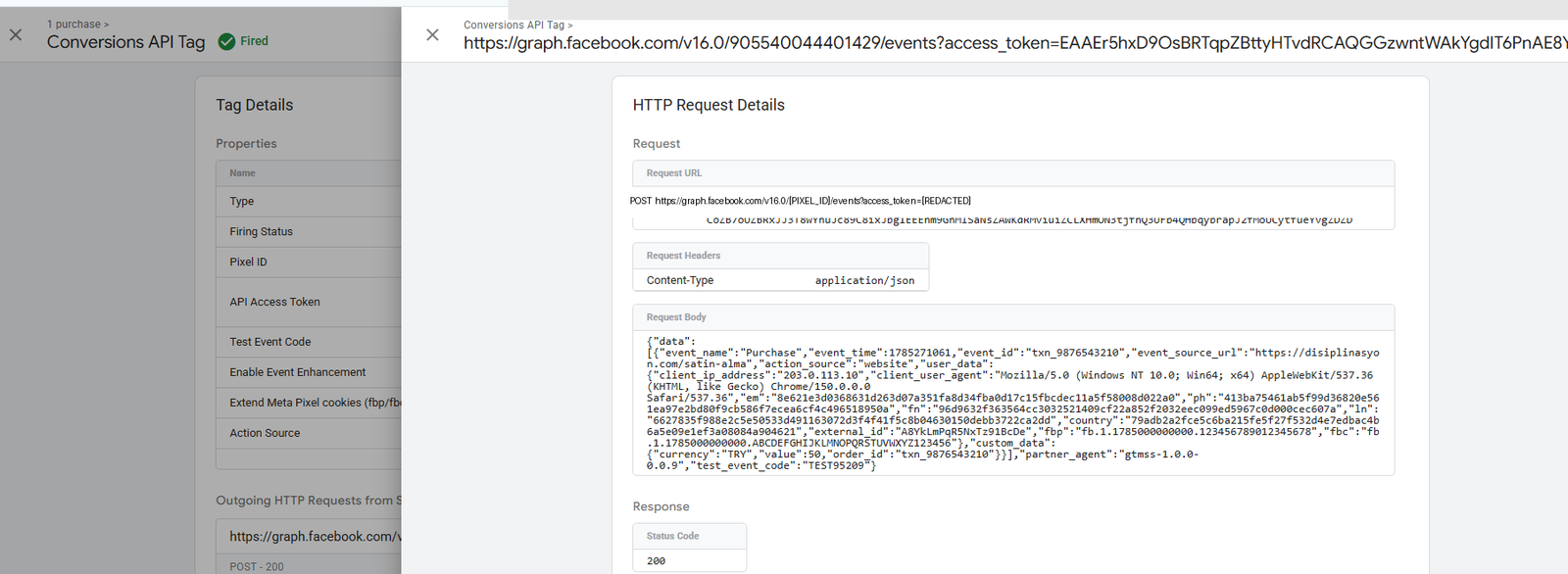
We mapped the recovered data into the exact schema Meta's Conversions API expects: hashed email and phone, fbp/fbc for browser-session matching, external_id for an additional stable match key, and client_ip_address/client_user_agent — the two fields most commonly missing from server-only integrations, and the ones with the largest impact on Meta's Event Match Quality score.
5. Verified in Meta Events Manager
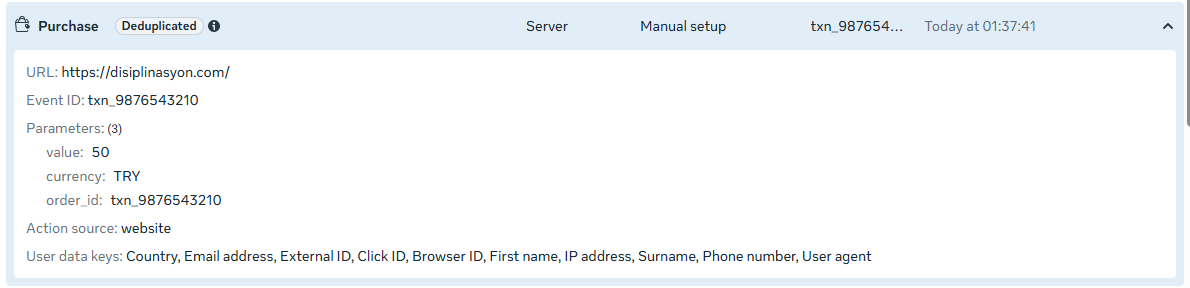
The final proof point: the Purchase event landing in Meta's own Events Manager, correctly deduplicated against any client-side signal, with a comprehensive set of matched user data keys.
Tools and Technologies
- GoHighLevel (Workflows, Webhooks, native attribution tracking)
- Google Tag Manager — Server-Side Container
- Custom Sandboxed JavaScript Client Template
- Meta Conversions API (community template)
- Postman (endpoint testing and payload validation)
Results
- Confirmed end-to-end delivery: a real test purchase flowed from GoHighLevel through the server container to Meta CAPI, appearing as a fully deduplicated Purchase event
- 10 matched user data keys per event — Country, Email, External ID, Click ID, Browser ID, First Name, IP Address, Surname, Phone Number, and User Agent — giving Meta's algorithm a strong optimisation signal
- Zero dependency on client-side Pixel or browser cookie persistence — events reach Meta reliably under iOS restrictions or in-app browser environments
- Deduplication-safe architecture using GoHighLevel's transaction ID as the event ID, protecting against double-counted conversions
- Reusable pattern extensible to leads, appointments, and upsells without re-architecting
Key Takeaways
This project underscored a pattern we see often with CRM-driven funnels: the attribution data usually already exists — it's just not exposed where you'd expect it. Rather than accepting "GoHighLevel doesn't support this," we went straight to the raw webhook payload and found everything needed already being captured natively. The fix wasn't a workaround or a third-party paid tool; it was building the right receiving layer to read data that was already there, and validating every step until Meta confirmed the event as fully deduplicated with strong match quality.
Why This Matters
For any business running paid social ads through a CRM/funnel platform like GoHighLevel, incomplete server-side tracking isn't just a reporting gap — it's a direct tax on ad performance, since Meta's delivery algorithm can only optimise toward signals it actually receives. This build closes that gap permanently, with an architecture that scales cleanly as the client adds more funnels, products, or ad platforms.
Adslytics.io specialises in server-side tracking, GTM architecture, and conversion API integrations for businesses running paid acquisition through CRM and funnel platforms. Contact us to audit your own tracking setup.
Need expert tracking setup?
Our Google Tag Manager experts have delivered 500+ tracking setups with a 98% success rate.
Get a Free Consultation →