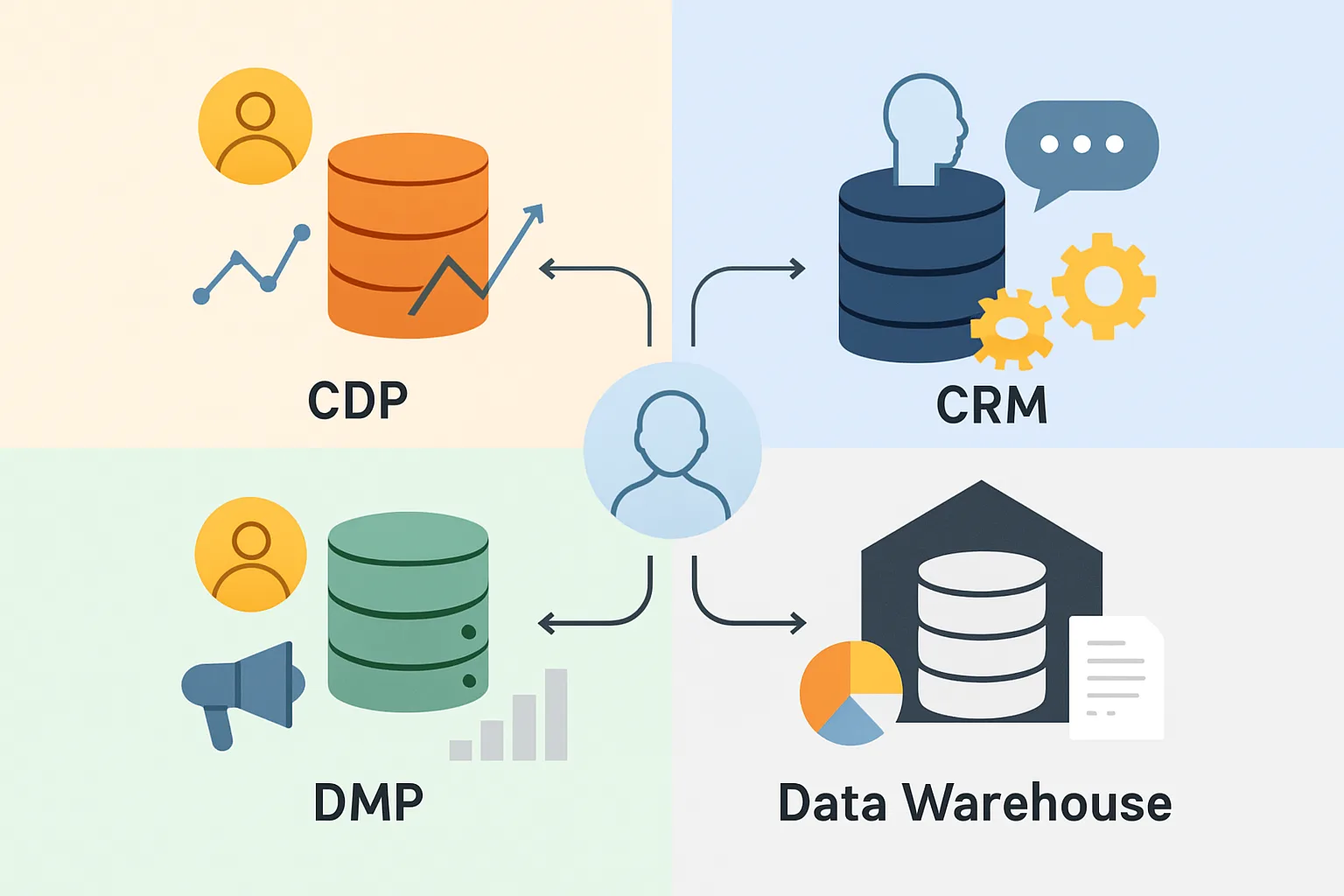
The Problem: Everyone Uses These Terms Differently
In the data and marketing world, CDP, CRM, DMP, and data warehouse get used interchangeably by vendors who want to appear more comprehensive than they are. This creates genuine confusion about what each tool actually does and why you might need each one.
This guide cuts through the noise with clear, practical distinctions. If you're evaluating customer data infrastructure for your business, our CDP implementation team can help you map the right tools to your specific needs.
Customer Data Platform (CDP)
Primary purpose: Collect first-party customer data from all sources, unify it into persistent profiles, and activate those profiles in marketing and business tools.
Key characteristics:
- Collects behavioral, transactional, and identity data
- Builds unified customer profiles with identity resolution
- Designed for marketing activation (syncs to ad platforms, email tools, CRM)
- Works with known (identified) and anonymous customers
- Primarily first-party data
Examples: Segment, Rudderstack, mParticle, Tealium AudienceStream, Lytics
Best for: Businesses wanting to personalize customer experiences across channels, improve ad targeting with first-party data, and unify siloed data sources.
Customer Relationship Management (CRM)
Primary purpose: Manage relationships and interactions with known customers and prospects throughout the sales cycle.
Key characteristics:
- Records of customer interactions, deals, and support history
- Sales pipeline management
- Contact and account management
- Designed for human-facing sales and support workflows
- Generally updated manually or via API by sales/support teams
Examples: Salesforce, HubSpot, Pipedrive, Zoho CRM
Best for: B2B companies with sales teams that need to manage prospect and customer relationships over time. Also valuable for B2C customer support workflows.
How it relates to CDP: The CDP is upstream of the CRM in many data architectures. The CDP collects behavioral data and can push enriched customer data (purchase history, engagement score, product usage) into the CRM to give sales teams better context.
Data Management Platform (DMP)
Primary purpose: Manage large audiences of anonymous, cookie-based users for advertising targeting — primarily using third-party data.
Key characteristics:
- Anonymous, cookie-based profiles
- Short data retention (90 days typical)
- Heavy on third-party audience data purchased from data brokers
- Designed for programmatic display advertising
- Not built for persistent customer identities
Examples: Oracle Data Cloud (BlueKai), Adobe Audience Manager, Salesforce DMP
Best for: Large brands running programmatic display advertising at scale who need third-party audience enrichment.
Current relevance: DMPs are declining in importance as third-party cookies disappear and first-party data becomes more valuable. Many businesses are replacing DMP functionality with CDP-driven first-party audiences.
Data Warehouse
Primary purpose: Store, organize, and query large volumes of structured data for business intelligence and analytics.
Key characteristics:
- SQL-queryable, optimized for analytical workloads
- Can hold any business data — not just customer data
- Not designed for real-time activation or marketing use cases natively
- Single source of truth for historical analysis
- Data analysts and engineers are primary users
Examples: Google BigQuery, Snowflake, Amazon Redshift, Databricks
Best for: Any organization needing reliable, scalable analytics across business functions. Essential infrastructure once you reach meaningful data volumes.
How They Fit Together
These tools aren't competitors — they're complementary:
- CDP collects events from your website, app, and marketing tools → builds unified customer profiles → activates audiences in marketing destinations
- Data Warehouse receives raw event data from the CDP for long-term storage and complex analytics queries
- CRM receives enriched customer profiles from the CDP, giving sales teams context about customer behavior
- DMP (where still used) supplements first-party CDP audiences with third-party data for programmatic campaigns
The composable alternative (increasingly popular): replace the traditional CDP with a Data Warehouse + Reverse ETL stack. Data is stored in BigQuery or Snowflake, then activated to marketing tools via Reverse ETL tools like Census or Hightouch.
Our CDP implementation service helps you navigate these architectural choices based on your team size, technical maturity, and use cases. Contact us for an architecture consultation.
Need expert tracking setup?
Our Google Tag Manager experts have delivered 500+ tracking setups with a 98% success rate.
Get a Free Consultation →