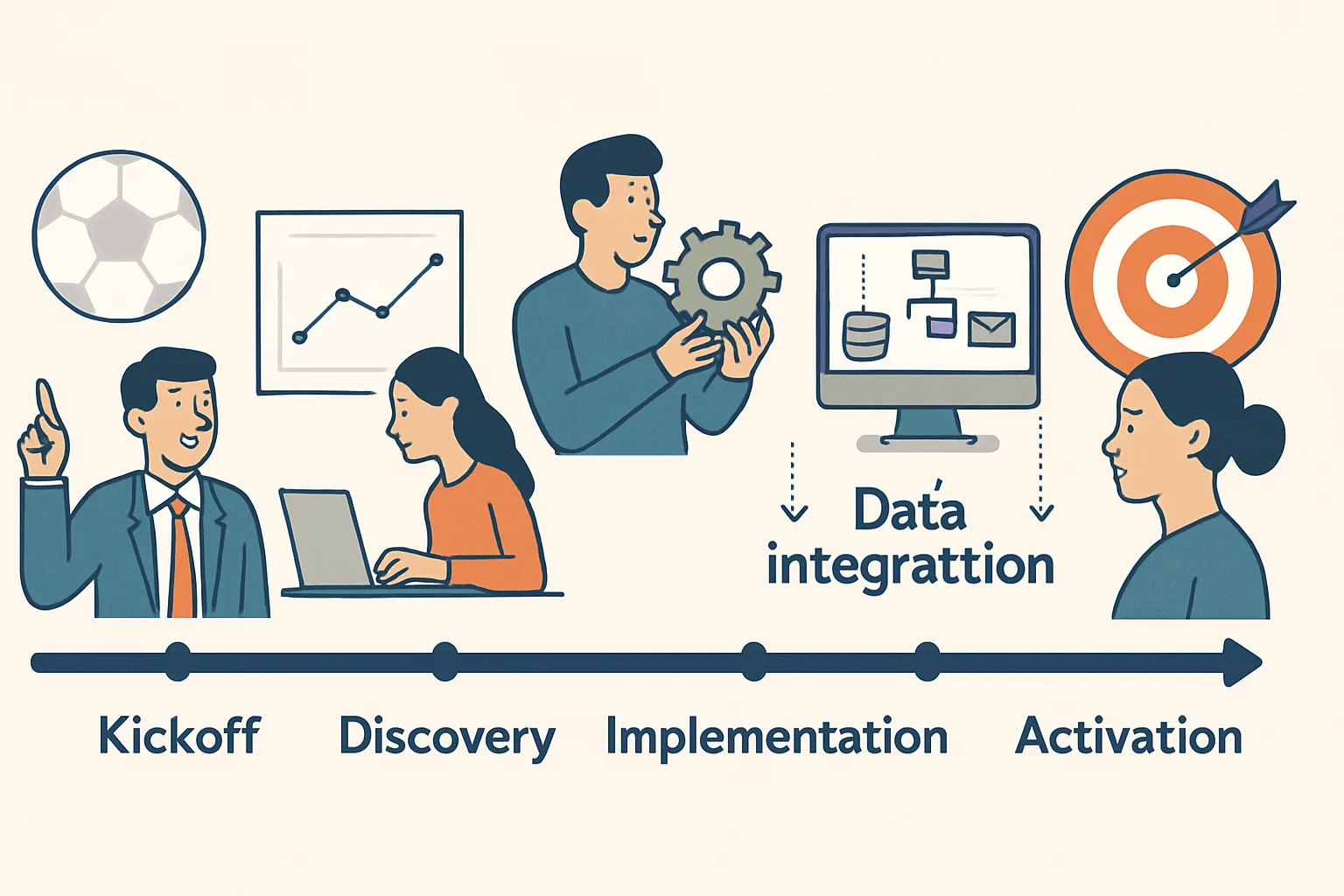
Setting Expectations for CDP Implementation
A CDP implementation is not a simple tag deploy. Depending on your data complexity, existing tracking quality, and number of sources, expect 6–16 weeks for a first meaningful activation. Rushing the process leads to poor data quality that undermines everything built on top.
Our CDP implementation team follows the roadmap below. The phases are sequential — each builds on the previous one.
Phase 1: Discovery and Use Case Definition (Weeks 1–2)
Goal: Define what success looks like and identify the high-value use cases that will drive ROI.
Activities:
- Stakeholder interviews: What data problems are you solving? What use cases justify the investment?
- Data source audit: What systems hold customer data today? (CRM, email, analytics, ads, product database, POS)
- Current tracking audit: Is your existing GTM tracking reliable? What events exist? What's missing?
- Use case prioritization: Rank desired outcomes by business value and implementation complexity
- Success metrics definition: How will you know the CDP is working 6 months post-launch?
Output: A prioritized use case document, data source map, and implementation scope.
Phase 2: Event Schema Design (Weeks 2–4)
Goal: Design the event taxonomy and property standards before writing a single line of code.
Activities:
- Define all Track events needed for priority use cases (e.g., Product Viewed, Add to Cart, Order Completed)
- Define Identify calls and the user traits to capture (email, name, plan, account ID)
- Define Page and Group calls if applicable
- Establish property naming conventions (snake_case vs camelCase, consistent value formats)
- Document in a Tracking Plan spreadsheet or tool (Segment Protocols, Avo, or a custom spreadsheet)
Output: A Tracking Plan document that becomes the source of truth for all event implementation.
Phase 3: Infrastructure Setup (Weeks 3–5)
Goal: Set up the CDP platform and initial destination connections.
Activities:
- CDP platform provisioning (Segment workspace, RudderStack setup, etc.)
- JavaScript snippet or SDK installation on web and app
- Configure priority destinations (Google Analytics, Google Ads, email platform, data warehouse)
- Set up data warehouse destination for all raw events
- Configure server-side sources for backend events
Phase 4: Event Implementation (Weeks 4–8)
Goal: Implement the Tracking Plan across all surfaces.
Activities:
- Developer implementation of track/identify calls on web (via GTM or direct code)
- Mobile SDK implementation for app events
- Server-side event implementation for backend events (purchases, subscriptions)
- Historical data backfill from CRM and database for existing customers
- QA: Verify each event fires correctly with expected properties using CDP debugger
Phase 5: Identity Resolution Configuration (Weeks 7–9)
Goal: Configure how the CDP merges anonymous and known profiles.
Activities:
- Define identity resolution rules (which identifiers can merge profiles: email, user ID, phone)
- Test merge scenarios: anonymous browse → identify on registration
- Configure cross-device stitching if required
- Validate profile completeness in CDP profile viewer
Phase 6: First Audience Activation (Weeks 8–12)
Goal: Launch the first revenue-generating use case using CDP audiences.
Examples of first activations:
- Cart abandoners (viewed product + no purchase in 24 hours) → Google Ads remarketing + email sequence
- High LTV customers → Google Ads Customer Match with higher bidding priority
- Trial users approaching expiry → targeted email campaign + sales CRM task creation
Measure the activation's impact carefully. The first success story is critical for stakeholder buy-in to continue CDP investment.
Phase 7: Measurement and Iteration (Ongoing)
After launch, the CDP is never "done." Ongoing work includes:
- Adding new events as products and features evolve
- Expanding to new destinations as marketing stack grows
- Building more sophisticated audiences as data volume increases
- Monitoring data quality and resolving issues
Contact our CDP team if you're planning an implementation and want expert guidance through this process. We handle the technical complexity so your team can focus on use case design.
Need expert tracking setup?
Our Google Tag Manager experts have delivered 500+ tracking setups with a 98% success rate.
Get a Free Consultation →