What Is a Composable CDP?
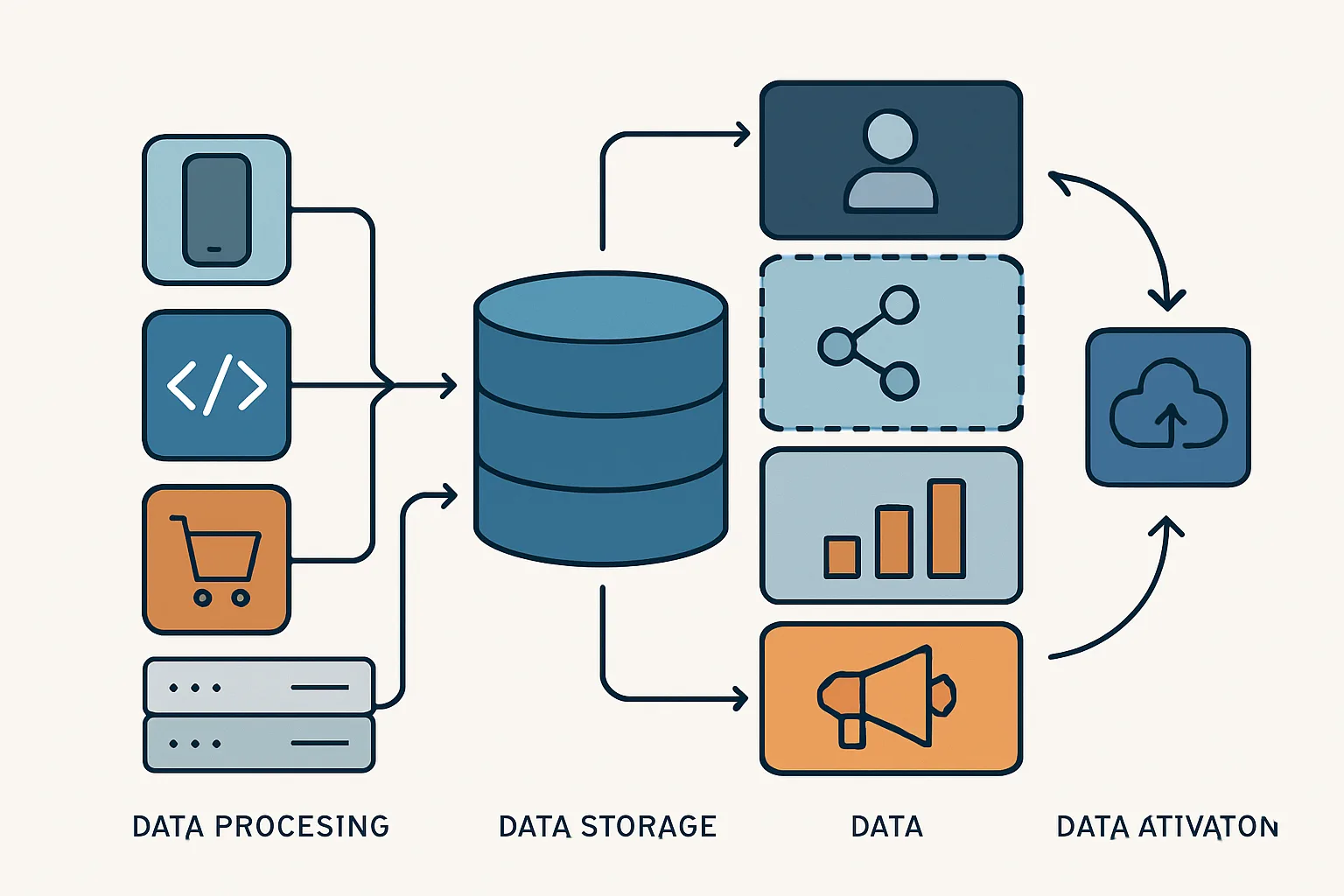
A composable CDP is an architecture — not a single product. Instead of buying a packaged CDP that collects, stores, and activates data in one proprietary system, you assemble best-of-breed tools that each do one thing well:
- Collection: Your existing tracking (GTM, server-side, event streaming)
- Storage and transformation: A data warehouse like Google BigQuery or Snowflake
- Activation: Reverse ETL tools (Census, Hightouch, Polytomic) that sync warehouse segments to marketing destinations
The warehouse becomes your system of record and the Reverse ETL layer becomes your activation mechanism. Together, they replicate what a traditional CDP does — often at lower cost and with more flexibility. Our data infrastructure team helps businesses design the right architecture for their maturity and use cases.
Traditional CDP vs. Composable CDP
Traditional CDP
- Data stored in the vendor's proprietary database
- Bundled collection + storage + activation
- Faster initial time to value
- Less SQL required from marketing teams
- Pricing tied to event/user volume (can escalate quickly)
- Vendor lock-in risk if you switch providers
Composable CDP
- Data stored in your own warehouse (you own it)
- Separate best-of-breed tools for each function
- Longer setup time but more flexibility
- Requires SQL knowledge in marketing or data team
- Often lower ongoing cost at scale
- No vendor lock-in for the data layer itself
The Core Components in Practice
The Warehouse: BigQuery or Snowflake
Your warehouse already receives data from multiple sources — your CRM, ecommerce platform, product database, and analytics tools. In a composable CDP, the warehouse becomes the unified customer profile store.
Tables you'd build or maintain:
users— unified customer records with identity attributesevents— all behavioral events across channelsorders— transaction historycomputed_traits— derived metrics (LTV, recency, engagement score)audience_memberships— segment assignments per user
dbt for Transformation
dbt (data build tool) transforms raw warehouse data into clean, modeled tables. It's where you write SQL models that create the computed_traits and audience_memberships tables above. The output is reliable, tested, documented customer data — the equivalent of a CDP's profile store.
Reverse ETL for Activation
Reverse ETL reads from your warehouse and syncs data to marketing destinations on a schedule or trigger:
- Push "high LTV customers who haven't purchased in 60 days" from BigQuery → Google Ads Customer Match
- Sync product usage scores from warehouse → Salesforce CRM as a field on each contact
- Update email platform segments based on warehouse audience queries
Tools like Census, Hightouch, and Polytomic have pre-built destination connectors to 100+ marketing and sales tools, making activation relatively straightforward once your warehouse data is clean.
When Composable Beats Traditional CDP
- Your team already has a data warehouse and uses SQL regularly
- You have complex data transformation requirements that go beyond what CDP visual builders handle
- You want your customer data to stay in your own infrastructure (GDPR data residency)
- Traditional CDP pricing at your data volumes would be prohibitive
- You want maximum flexibility to change downstream tools without migrating your entire data layer
When Traditional CDP Wins
- You need real-time event-based triggers (Reverse ETL typically runs on schedules, not real-time)
- Your marketing team needs a no-code audience builder without SQL skills
- You want to minimize infrastructure complexity and vendor management
- You need advanced identity resolution out of the box
- Time to value is the priority and you have budget for the packaged solution
The good news: you don't have to commit permanently. Many businesses start with a traditional CDP for speed, then migrate toward a composable architecture as their data team matures. Our CDP team can design the right architecture for your current stage and roadmap. Get in touch to discuss your options.
Need expert tracking setup?
Our Google Tag Manager experts have delivered 500+ tracking setups with a 98% success rate.
Get a Free Consultation →