Quick answer
How can CDP audience suppression reduce paid media waste?
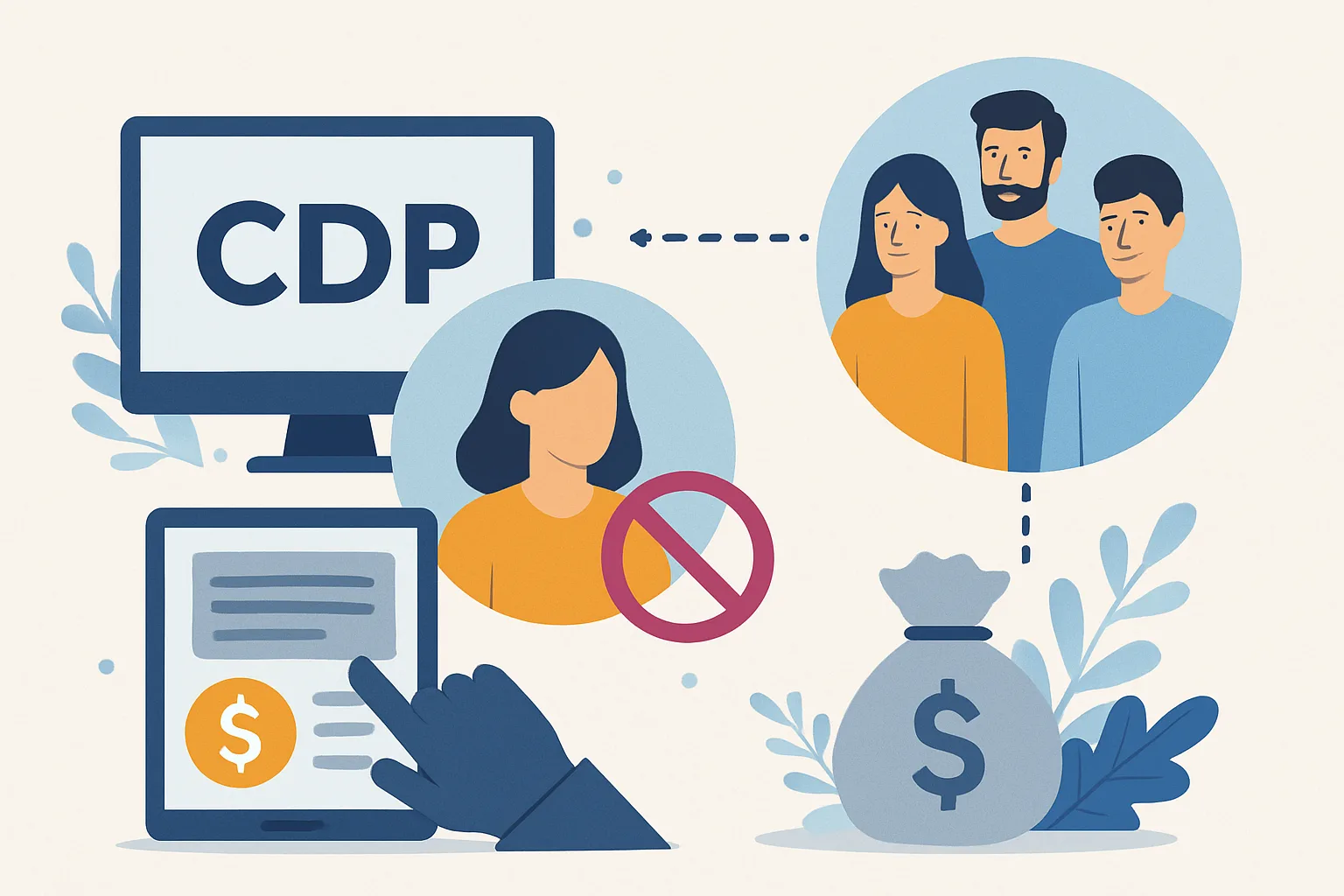
A CDP can send lists of existing customers, recent purchasers or unsubscribed contacts to ad platforms as exclusions. Your campaigns then stop paying to reach people who will not convert or have already converted, which lowers wasted spend.
The Budget Leak Nobody Talks About
Most businesses spend significant effort targeting new customers. Very few spend equal effort excluding people they shouldn't be targeting. The result: ad spend going to existing customers, recent converters, churned-and-gone users, and people who've explicitly opted out of marketing.
Suppression audiences, lists of people to exclude from specific campaigns, are often the single fastest ROI improvement in a CDP implementation. Our CDP team configures suppression audiences as a priority in every advertising integration setup.
Who to Suppress (And Why)
Existing Customers From Acquisition Campaigns
Your acquisition campaigns are optimized to attract new customers. Showing them to existing customers wastes budget, can confuse them with "new customer" offers, and skews your acquisition metrics.
Build a suppression list of all users with at least one completed purchase and sync it to Google Ads and Meta as an exclusion audience. This is the highest-impact suppression for most ecommerce businesses.
Recent Converters (30-Day Window)
Someone who converted 3 days ago doesn't need your acquisition ad. They need an onboarding experience. Suppress them from all upper-funnel campaigns for 30 days post-conversion, then move them into a cross-sell or upsell audience.
Active Trial Users From Prospect Campaigns
For SaaS companies: users who have already started a trial are in your funnel. Continuing to serve them top-of-funnel ads that say "Start Your Free Trial" is redundant. Suppress them and instead serve conversion-focused ads ("Ready to upgrade? See our plans") if you want to reach them via paid.
Churned and Unrecoverable Users
Some churned customers have explicitly stated they don't want to return (cancelled due to moving, changed needs, business closed). Identify these from your CRM data and suppress from all campaigns. Don't waste budget chasing unwinnable accounts.
Marketing Opt-Outs
Users who have unsubscribed from marketing emails should typically also be suppressed from paid advertising retargeting, especially under GDPR where consent withdrawal should be respected across channels. Your CDP's consent framework should automate this exclusion.
Calculating the Value of Suppression
To estimate suppression ROI:
- Find the percentage of your current ad clicks that come from existing customers (use UTM data in GA4 cross-referenced with your customer database)
- Multiply by your monthly ad spend
- This is the wasted spend that suppression audiences can recover
For most ecommerce businesses, 5-15% of acquisition ad spend goes to existing customers. At £10,000/month ad spend, that's £500-£1,500/month recoverable immediately from suppression alone.
Implementing Suppression in Your CDP
Suppression audiences work the same way as targeting audiences: you define who's in the list, and the CDP syncs it to your ad platforms as an exclusion rather than an inclusion.
In Google Ads: add the Customer Match list as an audience exclusion at the campaign level. In Meta: use the Custom Audience as an exclusion in your ad set targeting.
Suppression lists must stay current. The advantage of CDP-managed suppression is automatic updates: when someone converts, they're added to the suppression list within hours, not after your next manual CSV export.
Need help setting up suppression audiences? Contact our CDP team: this is typically a quick win we configure in the first weeks of any implementation.
Need expert tracking setup?
Our Google Tag Manager experts have delivered 500+ tracking setups with a 98% success rate.
Get a Free Consultation →