340% More Shopping Impressions Through Google Merchant Feed Optimisation
Electronics Retailer: 340% Shopping Impression Increase
📌 Introduction
A UK consumer electronics retailer with 3,200 SKUs was running Google Shopping campaigns with a £28,000/month budget but achieving disappointing impression share. Despite competitive pricing, their products weren't appearing for large volumes of relevant search traffic. A comprehensive product feed optimisation programme delivered 340% more impressions, 185% more Shopping clicks, and 220% more Shopping revenue — without increasing ad spend.
❗ The Problem
The client's Shopping campaigns had an average Impression Share of only 18% — meaning they were missing 82% of eligible searches. Even for branded searches of products they stocked, impression share was only 34%. Shopping CPCs were high at £1.80 average, and click-through rates were 0.8% — well below the 2-3% benchmarks for well-optimised electronics Shopping.
🔍 Identifying the Causes
Feed analysis revealed systemic quality issues that were limiting product matching and click-through rates. Product titles used manufacturer part number descriptions like "LG OLED65C24LA 65 Inch OLED evo C2 4K TV 2022" rather than consumer search terms like "LG 65 Inch 4K OLED Smart TV C2 Series | WebOS | Dolby Vision". Categories were mapped to broad first-level categories rather than specific subcategories. GTINs (EAN codes) were missing for 34% of products, causing them to be deprioritised in Shopping auctions. Product descriptions were manufacturer boilerplate rather than searchable consumer language. Key attributes like colour, connectivity, and screen resolution were absent from most listings.
⚠️ Consequences for the Business
Poor title relevance meant products matched to few search queries — most searches returned competitor products with better keyword optimisation. Missing GTINs caused those products to be treated as lower-quality data by Google and excluded from many Shopping auctions. Poor CTR meant even impressions that were won were converting at below-average rates, signalling to Google's algorithms that the products were lower quality than competitors.
✅ Solution
We executed a four-week feed transformation. Week 1: Built a consumer keyword research database for each product category using search volume data, autocomplete analysis, and competitor title auditing. Week 2: Rewrote all 3,200 product titles following a tested formula — [Brand] [Product Type] [Key Feature] [Secondary Attributes] [Model/Colour/Size] — incorporating high-volume consumer search terms. Week 3: Completed GTIN coverage by cross-referencing manufacturer databases and supplier data, achieving 97% GTIN coverage. Mapped all products to 4th-level Google taxonomy categories. Week 4: Enriched product descriptions with keyword-dense consumer language and added all available product attributes (colour, material, connectivity, compatibility). Implemented supplemental feed with custom labels for margin-based bidding segmentation.
📈 Results
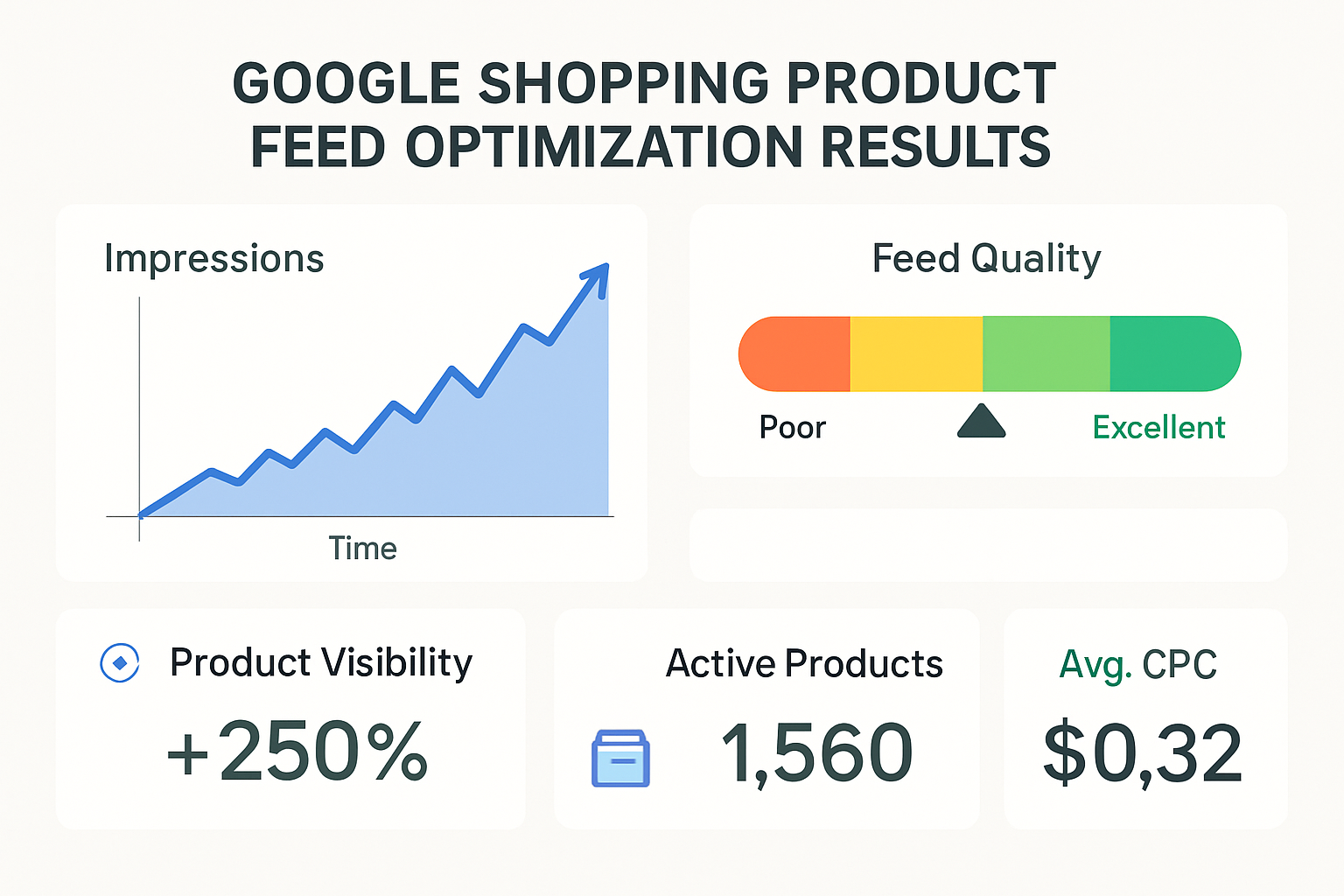
Results tracked over 90 days post-implementation: Shopping impressions increased 340% (from 280,000 to 1,230,000/month). Shopping clicks increased 185% (from 2,240 to 6,384/month). Shopping revenue increased 220% (from £56,000 to £179,200/month). Shopping ROAS improved from 2.0x to 6.4x. Average CPC decreased 31% (from £1.80 to £1.24) due to improved quality scores. Impression Share grew from 18% to 52%.
🏁 Conclusion
Product feed quality is the most underappreciated lever in Google Shopping performance. For this client, zero additional ad spend combined with systematic feed optimisation delivered more than 3x the Shopping revenue. Every e-commerce business running Google Shopping should audit their feed quality before increasing budgets.
💡 Key Takeaways
Product title optimisation with consumer search terms is the highest-impact single feed improvement. GTIN coverage directly affects auction eligibility and impression volume. Granular Google taxonomy mapping improves product matching precision. Feed optimisation produces compounding returns as improved quality scores reduce CPCs over time.
Talk to Us, It's Free
We are always willing to help. Let us know what you are looking for, and we will develop a unique solution for you.
Thank You!
Your message has been sent successfully. We'll get back to you soon.
Business Hours
Our support Hotline is available 24 Hours