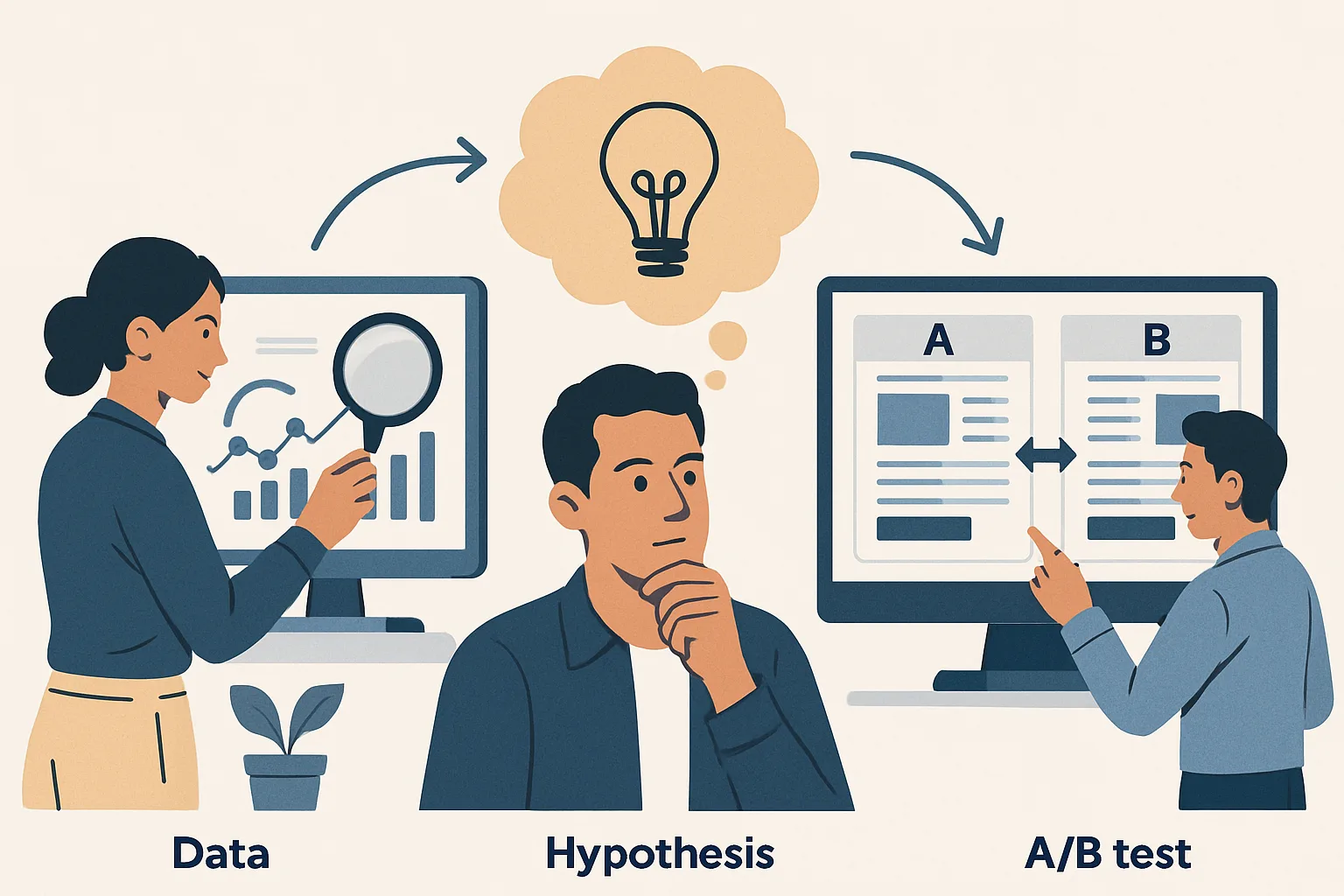
Why CRO Without Research Is Guesswork
Many "CRO programs" are actually design opinion programs — someone thinks the button should be bigger, or green instead of red, or the headline should say "Get Started" instead of "Sign Up." These tests produce random noise rather than learning.
CRO research produces hypotheses grounded in evidence — specific observations about what's broken, why it's broken, and what changing it should achieve. Evidence-based tests are more likely to win and more likely to produce transferable insights even when they don't win.
Our CRO team follows this research process on every engagement before any test is designed.
The Research Stack
CRO research draws from multiple data sources simultaneously. Each source illuminates a different dimension of the conversion problem:
- Quantitative analytics (GA4): Where is the drop-off? What's the magnitude?
- Heatmaps (Clarity/Hotjar): Where do users click, scroll to, and ignore?
- Session recordings: What does frustration look like on specific pages?
- Form analytics: Which specific field kills lead form completion?
- User surveys: What do users say they need that's missing?
- Customer interviews: What language do customers use to describe the problem you solve?
- Competitive analysis: What are others offering that you're not?
Phase 1: Quantitative Research (1–2 weeks)
Start with the data — no subjective input until you understand the numbers.
Tasks:
- Build funnel visualization from entry point to conversion across all key paths
- Identify the top 3 drop-off points by absolute user volume
- Segment performance by device, traffic source, and audience type
- Calculate conversion rate improvement value for each drop-off step (1% improvement = £X revenue)
- Identify pages with below-benchmark conversion rates in your category
Output: A prioritized list of "investigation areas" ranked by potential revenue impact.
Phase 2: Qualitative Research (2–3 weeks)
For each investigation area, gather qualitative evidence to explain the quantitative signal.
Tasks:
- Review 50+ session recordings filtered to users who dropped off at each identified step
- Analyze heatmaps on each drop-off page (click, scroll, move maps)
- Review form analytics if forms are a drop-off point
- Deploy exit survey on drop-off pages ("What prevented you from continuing today?")
- Review support tickets and chat transcripts for recurring objections and confusion points
Output: A set of observations, each linked to the quantitative drop-off it explains.
Phase 3: Hypothesis Formation
Convert each observation into a testable hypothesis using this structure:
Template: "We believe that [change] will [outcome] because [evidence]. We'll know this worked if [metric] improves by [threshold]."
Example (bad hypothesis): "We think changing the button color will improve conversions."
Example (good hypothesis): "We believe that adding shipping cost information to the product page (before checkout) will reduce checkout abandonment by 15%, because session recordings show 28% of checkout abandoners leave within 5 seconds of seeing the shipping cost at checkout — indicating unexpected price shock. We'll know this worked if checkout initiation rate from product pages improves by >10%."
Phase 4: Test Design
For each validated hypothesis, design the minimum experiment that can confirm or deny it:
- Define control (current experience) and variant (proposed change)
- Calculate required sample size for statistical significance (use a sample size calculator — underpowered tests are worthless)
- Define primary success metric (conversion rate) and guardrail metrics (don't improve conversions at the expense of revenue per order)
- Set test duration based on required sample size and your traffic volume
- Brief development on what needs to be built for the variant
Quality Check: Is Your Hypothesis Ready?
- ✅ Is it grounded in at least 2 independent data sources (not just "I think")?
- ✅ Does it make a specific, falsifiable prediction?
- ✅ Is the change isolated enough to attribute results?
- ✅ Is the expected impact significant enough to justify the testing cost?
Our CRO team runs this full research process before every client engagement. The result is a hypothesis backlog of 10–20 validated tests, prioritized by potential impact. Contact us to build a CRO research program for your site.
Need expert tracking setup?
Our Google Tag Manager experts have delivered 500+ tracking setups with a 98% success rate.
Get a Free Consultation →