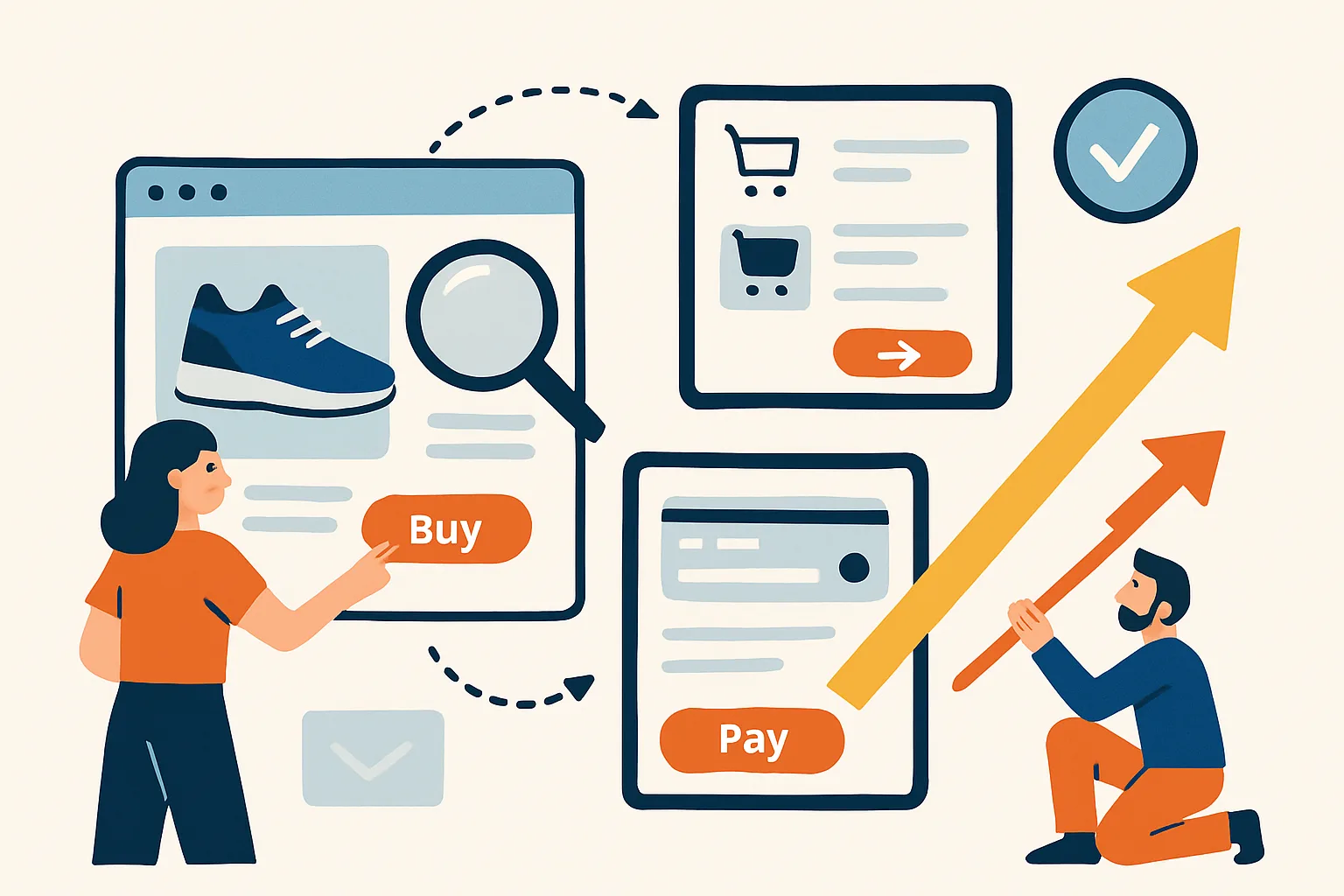
The Three-Stage Ecommerce Conversion Problem
Ecommerce conversion optimization requires understanding that there are three distinct stages where users are lost — and each has different root causes and different solutions:
- Product Detail Page (PDP): Users aren't convinced to add to cart
- Cart: Users add items but don't initiate checkout
- Checkout: Users start checkout but don't complete purchase
Start with the stage that has the largest absolute user loss (from your GA4 funnel data). Our CRO team works through each stage systematically.
Product Detail Page (PDP) Optimization
Images Drive Add-to-Cart More Than Any Other Element
Multiple high-quality product images from multiple angles, on-model shots (for apparel), lifestyle context images, and 360-degree views consistently increase add-to-cart rates by 20–40% vs. single product shot.
Video demonstrations for complex or considered-purchase products (electronics, tools, supplements) dramatically increase confidence and conversion.
Reduce Risk with Social Proof
- Review count and average rating visible near the add-to-cart button
- Real user-generated photos (Instagram-style) in the review section
- Specific review highlights extracted by AI or manual curation
Urgency and Scarcity (When Real)
Stock count ("Only 3 left!") and sales velocity ("47 people have this in their cart") increase urgency — but only when true. Fake scarcity destroys trust when users notice it.
Variant Selection UX
Color and size selectors that show out-of-stock variants as crossed-out rather than removing them preserve conversion — users can see what's available in their preferred color even if their size isn't. Crossed-out variants don't frustrate; they help users adapt.
Cart Page Optimization
Show Free Shipping Progress
If you have a free shipping threshold, a progress bar ("Add £12 more for free shipping!") increases AOV and reduces cart abandonment simultaneously. This is one of the highest-ROI cart optimizations.
Trust Signals at Cart
Reiterate: return policy, security badges, accepted payment methods. Users pause at cart to reconsider — give them reasons to continue.
Cross-Sell Without Distraction
"Frequently bought together" or "Complete the look" recommendations at cart increase AOV without significantly reducing checkout initiation if placement is beneath the main cart content (not interrupting the checkout flow path).
Persistent Cart
Cart contents should persist across sessions and devices (for logged-in users). Nothing kills checkout conversion faster than a cart that empties when the user returns 2 hours later.
Checkout Optimization
One-Page vs. Multi-Step
The data is mixed. One-page checkouts show better performance for simple orders (few fields, single shipping address). Multi-step is often better for complex configurations. The most important factor is field count — minimize it regardless of layout.
Express Checkout Options
Apple Pay, Google Pay, and Shop Pay reduce mobile checkout to 1–2 taps. For stores with high mobile traffic, these payment methods often generate 10–20% more mobile revenue when added.
Place express checkout options prominently at the top of checkout, before the form — "express checkout" above, "or fill in your details" below.
Order Confirmation Page
The confirmation page is under-utilized. Consider:
- Upsell with complementary products (user is already in purchase mode)
- Referral offer ("Give a friend 10% off, you get 10% off your next order")
- Account creation incentive (if they checked out as guest)
- Post-purchase survey ("What almost stopped you from buying today?")
Ensure all ecommerce tracking events are firing correctly to measure each stage. Our CRO team runs systematic ecommerce CRO programs. Contact us for an ecommerce conversion audit.
Need expert tracking setup?
Our Google Tag Manager experts have delivered 500+ tracking setups with a 98% success rate.
Get a Free Consultation →