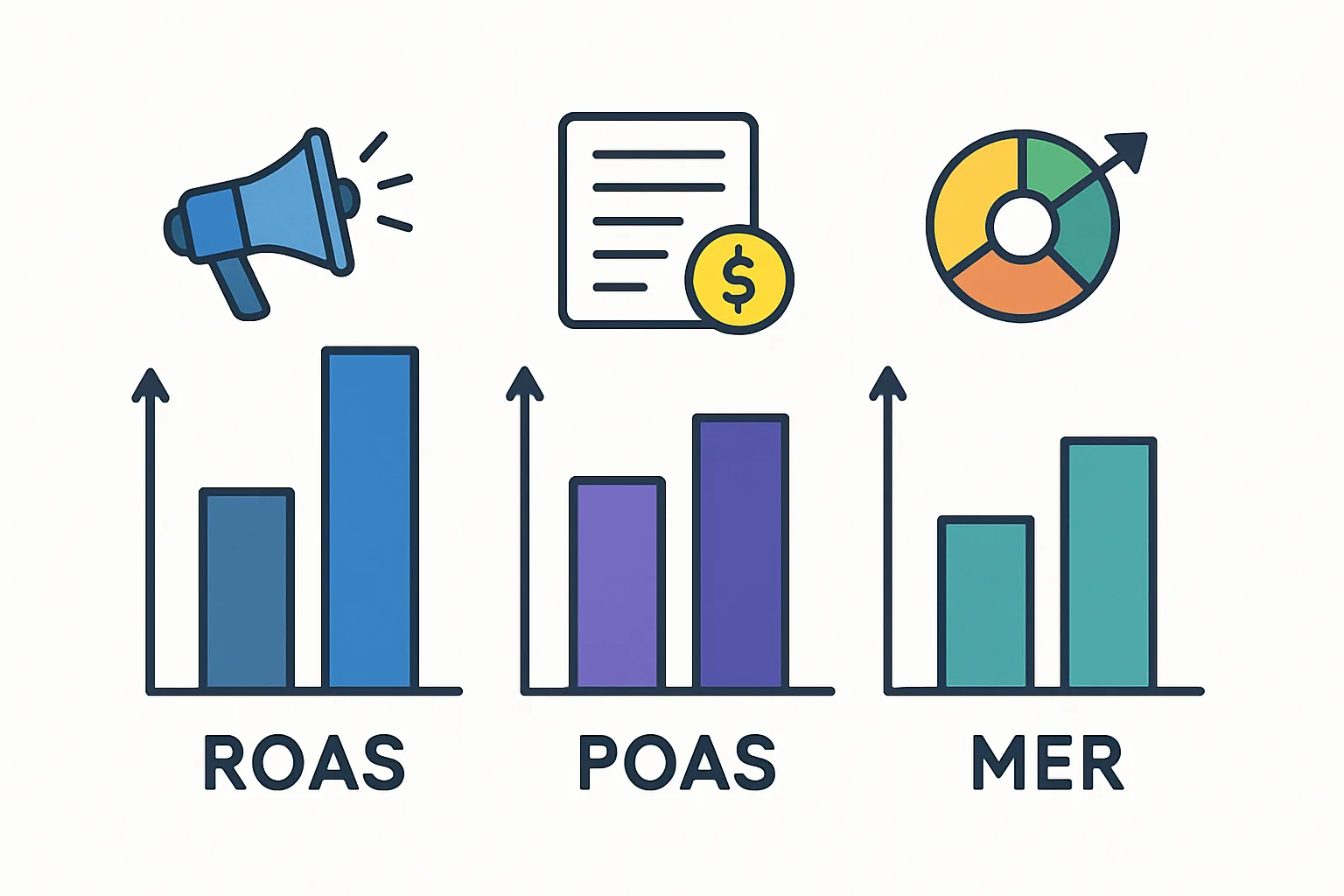
Why ROAS Alone Is Misleading
Return on Ad Spend (ROAS) is the most common marketing efficiency metric. It's also incomplete in ways that lead to systematically bad budget decisions. Understanding its limitations — and when POAS or MER is the better measure — is essential for accurate performance evaluation.
Our marketing analytics team regularly restructures client measurement systems around the right efficiency metric for their business model.
ROAS (Return on Ad Spend)
Formula: Revenue / Ad Spend
Example: £100,000 revenue from £20,000 Google Ads spend = 5x ROAS
Limitation: Revenue is the wrong numerator. ROAS ignores profit margins, cost of goods sold, and fixed costs. A 5x ROAS selling £100 products with 20% gross margin (£20 profit) means you're spending £20 on ads to make £20 gross profit — before paying for operations, software, salaries, or anything else. That's actually a losing business at 5x ROAS.
ROAS is only valid when compared to a target that accounts for your gross margin. A business with 60% gross margin needs a much lower ROAS target than a business with 20% gross margin.
POAS (Profit on Ad Spend)
Formula: Gross Profit / Ad Spend
Example: £30,000 gross profit from orders driven by £20,000 ad spend = 1.5x POAS
Why it's better: Uses profit instead of revenue, making it directly comparable to ad cost and business-meaningful.
Target: POAS > 1 means the ads generated more profit than they cost. A target of 1.5–2.5x POAS is common depending on whether you're prioritizing growth vs. profitability.
Challenge: Requires gross profit data in your analytics stack. Either pass product-level margin data to GA4 as a custom parameter, or calculate POAS in BigQuery by joining ad spend data with order margin data.
Best for: Ecommerce businesses with variable margins across products or categories.
MER (Marketing Efficiency Ratio)
Formula: Total Revenue / Total Marketing Spend
Example: £500,000 monthly revenue / £80,000 total marketing spend = 6.25 MER
Why it's different: MER is a blended metric across ALL channels and ALL revenue — not attributed to specific campaigns. It captures the total return of your entire marketing system, not individual channel attribution.
Why it matters: As attribution becomes less reliable (iOS privacy, cookieless tracking), channel-level ROAS becomes noisier. MER is attribution-agnostic — it doesn't care which channel gets credit, only whether total revenue is rising relative to total spend.
When to use: As a top-level health metric reviewed monthly alongside channel-level ROAS. When MER is declining while channel ROAS looks stable, there's either attribution inflation or a systemic efficiency problem.
Limitation: MER doesn't tell you which channels are working or where to allocate budget — it only tells you if the system as a whole is efficient.
The Right Metric for Your Situation
| Situation | Best metric |
|---|---|
| Uniform margins, simple tracking | ROAS with margin-adjusted target |
| Variable margins, profit-focused | POAS |
| Multiple channels, attribution concerns | MER (blended) |
| Mature analytics program | All three, used at different levels |
Our marketing analytics team restructures efficiency measurement as part of every analytics engagement. Contact us to evaluate which efficiency metric is right for your business.
Need expert tracking setup?
Our Google Tag Manager experts have delivered 500+ tracking setups with a 98% success rate.
Get a Free Consultation →