The Manual Audience Management Problem
Without a CDP, managing customer audiences is painfully manual. You export a CSV from your CRM, upload it to Google Ads, then upload to Facebook, then to your email platform. A week later, the list is stale. New customers aren't on it. Converted prospects aren't removed. Churned customers are still being served acquisition ads.
This process costs time, introduces errors, and produces poor marketing outcomes. A CDP solves it by making audience management a one-time definition exercise — you define the segment once, and it automatically stays current everywhere.
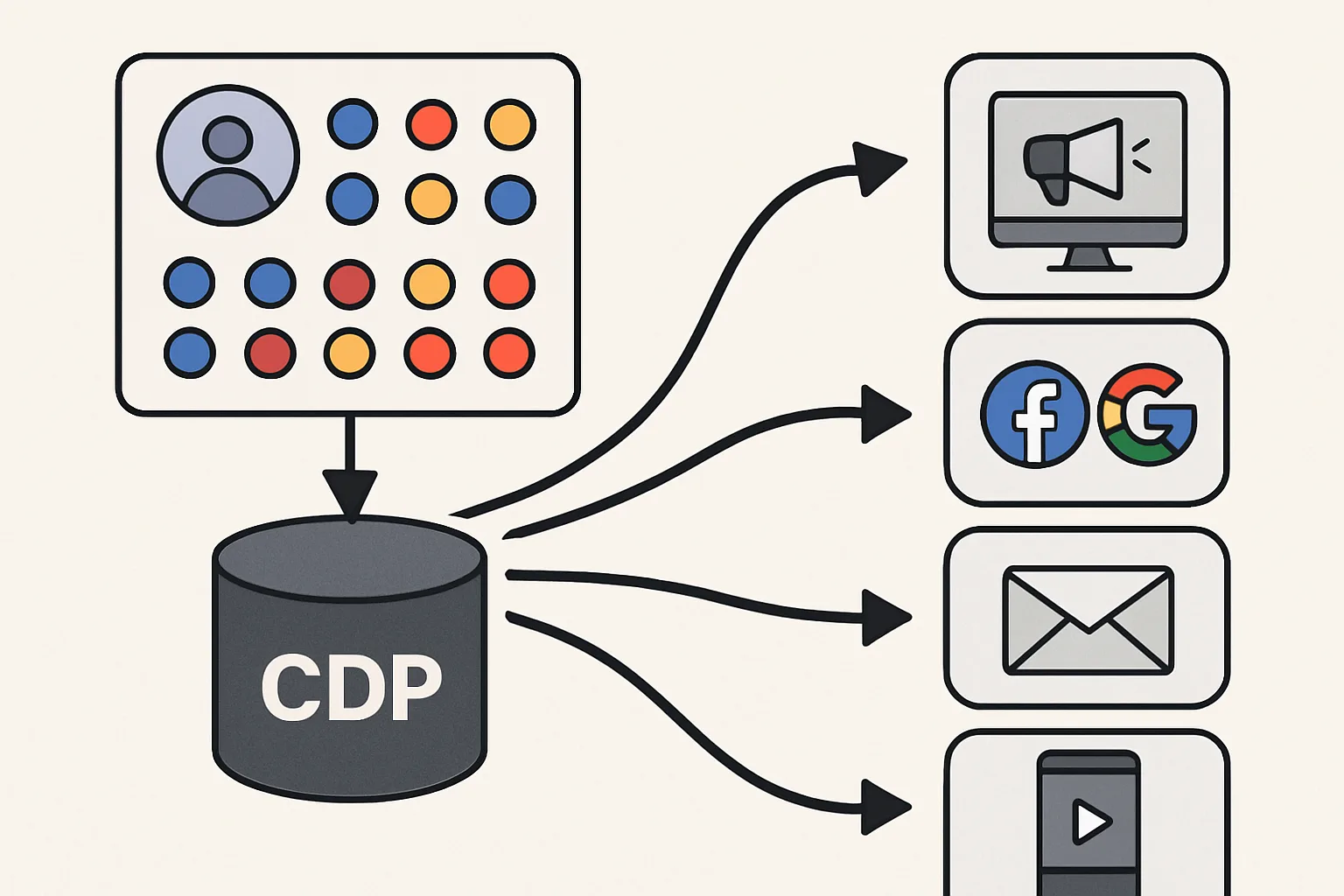
The Audience Syncing Architecture
In a CDP-powered setup:
- You define an audience using behavioral and profile conditions in the CDP
- The CDP continuously evaluates all customer profiles against these conditions
- When a customer enters or exits an audience, the CDP updates every connected destination in real-time or near-real-time
- Your Google Ads Customer Match list, Meta Custom Audience, and email platform segment are always synchronized
Our CDP implementation team configures these pipelines as part of every implementation.
Building Effective Audience Segments
Behavioral Segments
Based on actions users have taken:
- "Users who viewed the Pricing page but haven't signed up" → Retargeting with offer
- "Users who completed onboarding step 1 but not step 2 in 7 days" → Activation email
- "Users who purchased in the last 30 days" → Exclude from acquisition, include in upsell
- "Users who used the product 3+ times in the last 14 days" → Expansion campaign
Trait-Based Segments
Based on profile attributes:
- "Customers with LTV > £500" → VIP treatment, higher bid adjustment in ads
- "Free trial users on day 7" → Convert to paid campaign
- "Customers in Enterprise plan who haven't used feature X" → Feature adoption campaign
Predictive Segments
Based on CDP-calculated predictions:
- "Users predicted to purchase within 30 days" → Proactive outreach
- "Users with high churn probability" → Retention intervention
- "Users likely to upgrade from free to paid" → Upgrade campaign
These predictions are typically calculated in your data warehouse via ML models, then synced back to the CDP as computed traits that audiences can be built on.
Audience Syncing to Specific Platforms
Google Ads Customer Match
CDP syncs email/phone lists daily. Google hashes them and matches to its user base. Your campaign audience automatically reflects current segment membership. Use these for RLSA bid adjustments, exclusions, or similar audience targeting in Performance Max.
Meta Custom Audiences
Same principle as Google. CDP sends hashed PII lists. Use for lookalike seed audiences, exclusions, and remarketing. CDP syncing ensures your Custom Audiences don't expire (Meta deactivates audiences if not updated regularly).
Email Platform Segments
CDP triggers email platform segment additions/removals as users enter/exit audiences. Enables:
- Trigger-based email sequences (user enters "abandoned cart" audience → automatic 3-email sequence starts)
- Suppressions (user purchases → exits "cart abandoner" audience → email sequence stops)
- Dynamic segment-based campaigns (monthly email sends only to "active users" segment)
Measuring Audience Sync Performance
Track these metrics to evaluate your audience syncing ROI:
- Match rates per platform and audience
- Conversion rate improvement for synced audiences vs. prior manual uploads
- CPL/CPA for campaigns targeting synced first-party audiences vs. interest-based targeting
- Audience freshness — average lag between customer action and audience update
Connect your audience performance data to marketing analytics reporting for a complete picture of CDP ROI. Contact us to set up your audience syncing infrastructure.
Need expert tracking setup?
Our Google Tag Manager experts have delivered 500+ tracking setups with a 98% success rate.
Get a Free Consultation →