What Attribution Solves (and What It Can't)
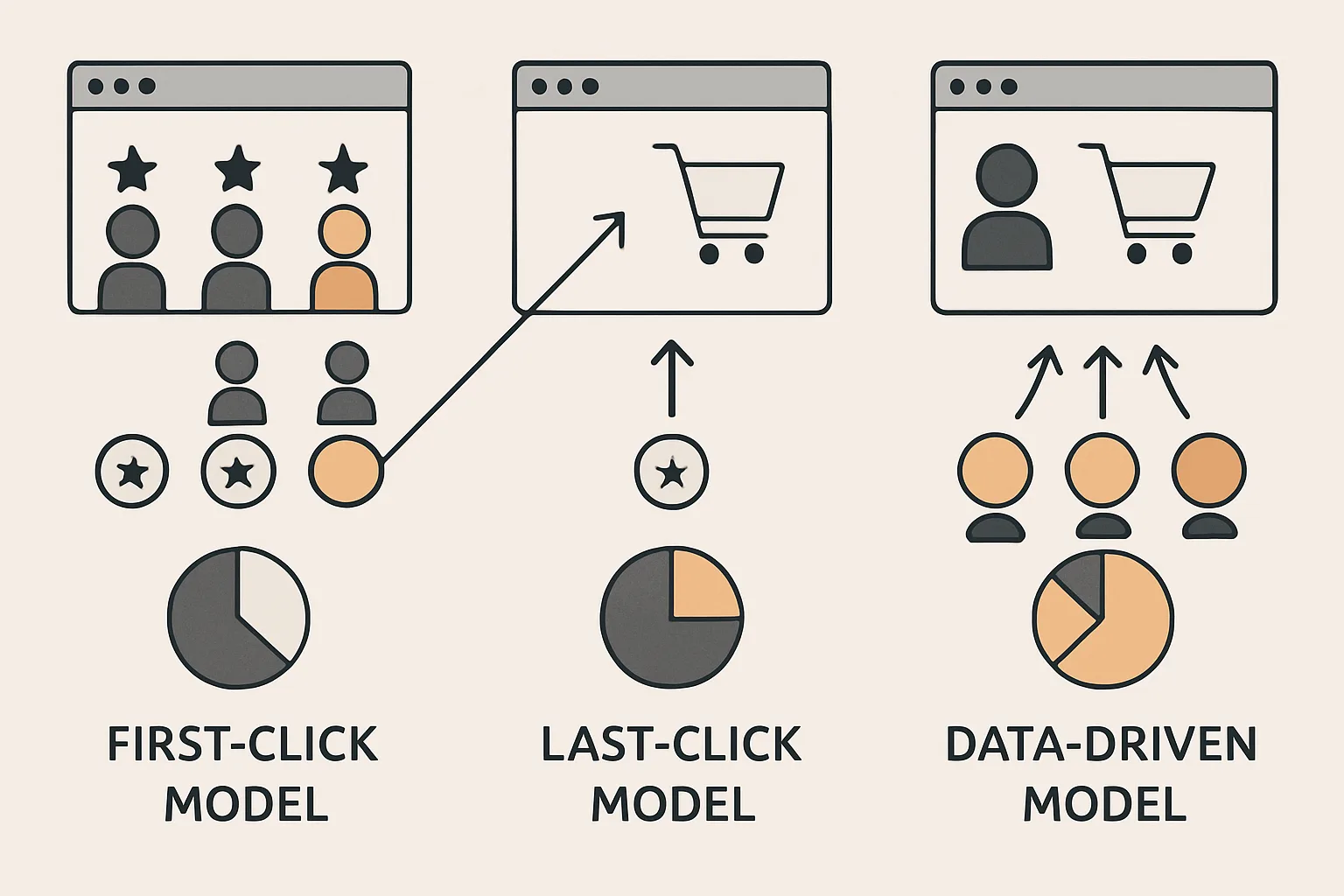
Most customers touch multiple marketing channels before converting: they see a Facebook ad, read a blog post, search your brand on Google, and finally click a Google Ads retargeting ad to purchase. Attribution determines which of these touchpoints gets credit for the conversion.
Attribution is important because budget allocation follows credit — if retargeting always gets last-click credit, you'll over-invest in retargeting and under-invest in the top-of-funnel channels that initiated the journey. Our marketing analytics team helps clients choose appropriate attribution models and understand their limitations.
The Standard Attribution Models
Last Click
100% of credit goes to the final touchpoint before conversion.
Pros: Simple, easy to explain, easy to implement.
Cons: Dramatically over-credits retargeting and brand search. Under-credits awareness and consideration channels. Incentivizes over-investment in bottom-funnel.
When to use: Short sales cycles, single-channel businesses, or as a baseline comparison.
First Click
100% of credit goes to the first touchpoint.
Pros: Values customer acquisition channels.
Cons: Ignores all subsequent touchpoints. Over-credits discovery channels, under-credits conversion drivers.
When to use: New market entry where discovery is the priority.
Linear
Equal credit distributed across all touchpoints.
Pros: All channels get some credit. Simple.
Cons: Treats all touchpoints as equally valuable — a display impression 6 months ago gets the same credit as the conversion click today.
Time Decay
More credit to touchpoints closer to conversion. Exponential decay going backward.
Pros: Reflects that more recent interactions were more influential.
Cons: Still undervalues awareness channels. Bias toward bottom-funnel.
When to use: Short consideration cycles where recency genuinely matters more than discovery.
Position-Based (U-Shaped)
40% to first touch, 40% to last touch, 20% distributed across middle touchpoints.
Pros: Values both discovery and conversion. More nuanced than single-touch models.
Cons: The specific percentages (40/40/20) are arbitrary. Middle touchpoints are still undervalued.
When to use: Long consideration cycles where both first touch (awareness) and last touch (conversion) are strategically important.
Data-Driven Attribution (DDA)
Machine learning model trained on your actual conversion paths. Assigns fractional credit based on observed lift from each touchpoint.
Pros: Based on your actual data. Theoretically most accurate within single-platform view.
Cons: Requires minimum conversion volume (Google requires ~3,000 conversions in 30 days). Black box — you can't audit the model. Cross-channel paths (email + paid) aren't fully captured in a single platform's DDA.
Default in GA4 and Google Ads. Better than last-click for most advertisers who qualify.
Cross-Channel Attribution: The Hard Problem
All the above models have a fatal flaw: they can only see touchpoints tracked by the specific platform. Google Ads DDA sees Google touchpoints; it doesn't see the email that preceded the search, or the social post that preceded the email.
True cross-channel attribution requires a unified data layer — either a CDP collecting all touchpoints, or a data warehouse joining data from all sources — to build a complete picture before applying any attribution model.
Our marketing analytics team builds cross-channel attribution solutions using GA4 and BigQuery. Contact us to design the right attribution model for your business.
Need expert tracking setup?
Our Google Tag Manager experts have delivered 500+ tracking setups with a 98% success rate.
Get a Free Consultation →