Growing E-commerce Paid Search Revenue 265% for a Premium Beauty Brand
Beauty Brand: 3.6x SEM Revenue Growth
📌 Introduction
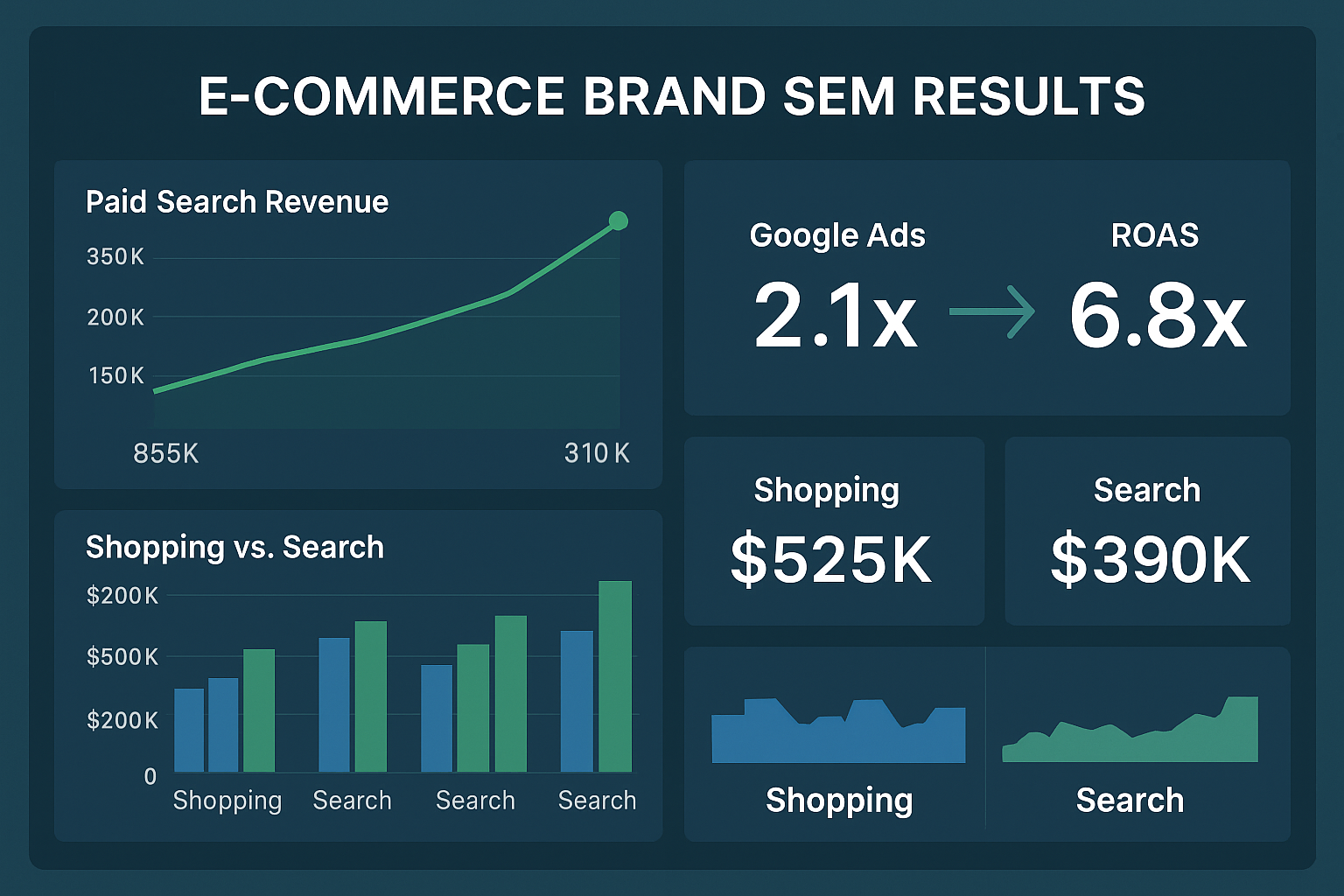
A premium UK beauty brand with a strong organic presence and loyal customer base was underinvesting in paid search, generating only £85,000/month from Google Shopping and Search combined. They had avoided scaling SEM due to previous experiences with poor ROAS. After a complete SEM programme redesign integrating Google Shopping, Performance Max, and Microsoft Advertising with precision audience targeting, monthly SEM revenue reached £310,000 at a 5.8x ROAS.
❗ The Problem
The brand's reluctance to scale SEM was rooted in past experience: a previous agency had scaled spend from £15,000 to £40,000/month over six months, but ROAS had fallen from 4.2x to 2.1x — making the increased revenue unprofitable. Leadership had concluded SEM couldn't scale profitably for their business. They continued at £20,000/month as a defensive measure to protect branded search but had largely abandoned growth-focused SEM.
🔍 Identifying the Causes
Our audit of both the current account and historical data from the previous agency revealed why scaling had failed. The previous approach used undifferentiated budget scaling — increasing spend equally across all campaigns including many that had consistently poor ROAS. There was no product segmentation by margin or performance tier. Audience targeting was minimal — no customer match, no RLSA. The product feed had never been optimised. And critically, there was no Microsoft Advertising presence despite the beauty demographic over-indexing significantly on Bing.
⚠️ Consequences for the Business
Unstructured scaling diluted performance by throwing budget at underperforming campaigns alongside strong ones, dragging average ROAS down as spend increased. Without product margin segmentation, the most aggressively bid products were often the lowest margin items. Without customer match and RLSA, the brand was competing on equal terms with acquisition campaigns even for existing customers who could be won at a fraction of the acquisition cost.
✅ Solution
We built a full-funnel SEM architecture with three pillars. Pillar 1 — Google Shopping with margin-based segmentation: Products segmented into four tiers using custom labels (Hero products: >50% margin + high conversion, Core: standard margin + strong conversion, Tactical: high volume/lower margin, Clearance: end-of-season). Bidding targets set per tier based on margin-weighted ROAS goals. Performance Max: Launched alongside Standard Shopping with 5 asset groups covering key product categories. Customer email list (240,000 subscribers) as primary audience signal plus 180-day purchaser list. Pillar 2 — Search campaigns for branded and competitor terms: Robust branded protection with maximum impression share. Competitor brand campaigns targeting the top 8 beauty brands with comparison messaging. Category intent Search campaigns ("best SPF moisturiser", "luxury face serum UK"). Pillar 3 — Microsoft Advertising: Full Shopping + Search buildout on Bing. Beauty category performs exceptionally well on Bing due to demographic alignment (35-55 female, higher income). ROAS on Microsoft reached 7.2x in month 3 — higher than Google.
📈 Results
Month 2: ROAS stabilised at 5.1x on existing spend — confidence established for scaling. Month 3: Budget increased to £32,000. Revenue: £163,000. Month 4: Microsoft Ads contributing £28,000 revenue at 7.2x ROAS. Month 6: Total SEM budget £54,000. Monthly SEM revenue: £310,000. Overall ROAS: 5.8x. New customer acquisition from SEM: 2,100/month (up from 580). Revenue from existing customers via RLSA and customer match: £67,000/month incremental to organic.
🏁 Conclusion
Profitable SEM scaling requires systematic architecture, not budget increases. Margin-based product segmentation, audience layering with customer data, full-funnel campaign structure, and multi-platform presence are the foundations that enable SEM to scale without ROAS decline. For established brands with customer lists, SEM can be simultaneously a growth and retention channel.
💡 Key Takeaways
Product margin segmentation is the foundation of profitable Shopping at scale — bid by margin tier, not by product category. Customer match and RLSA create a competitive advantage for established brands that new competitors can't replicate. Microsoft Advertising often delivers higher ROAS than Google in demographically aligned categories. Scaling should follow ROAS stability at each budget level — not a fixed timeline.
Talk to Us, It's Free
We are always willing to help. Let us know what you are looking for, and we will develop a unique solution for you.
Thank You!
Your message has been sent successfully. We'll get back to you soon.
Business Hours
Our support Hotline is available 24 Hours