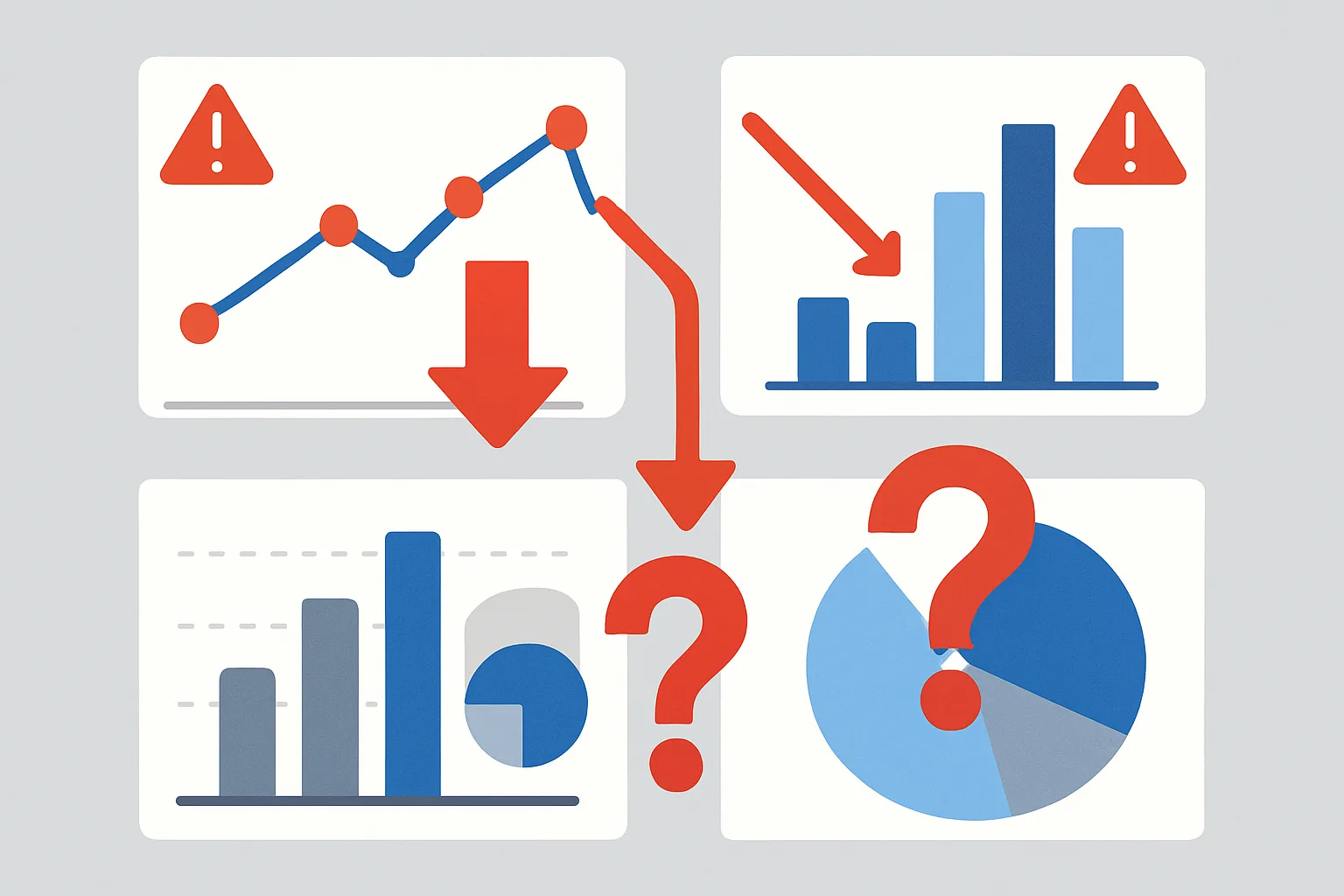
The Discrepancy That Erodes Trust in Your Data
You check Google Ads and it shows 45 conversions last month. You check your CRM — 28 new customers. You check your payment processor — 31 sales. Which number is right?
This gap between reported conversions and actual business results is one of the most common and most damaging issues in Google Ads. It erodes trust in your data, makes budget decisions harder, and can cause Smart Bidding to optimise for the wrong thing.
Here are the most common causes, and what to do about each.
Reason 1: You Are Counting Page Views, Not Actions
How it happens: You set up a conversion that fires on the thank-you page URL. But the thank-you page is accessible to anyone who types the URL directly.
Fix: Use server-side form submission tracking instead of page view tracking. Only load the thank-you page after a verified form submission, not just a page visit.
Reason 2: Double-Counting Conversions
How it happens: You have both a Google Ads conversion tag AND an imported GA4 event tracking the same action.
Fix: Audit your active conversion actions. Look for duplicate conversion actions covering the same event. Remove or pause duplicates.
Reason 3: Conversion Counting Set to Every Instead of One
How it happens: Your conversion action is set to count "Every" conversion, and some users are submitting the form multiple times.
Fix: For lead forms and contact requests, set conversion counting to "One" (one conversion per user per conversion window). Only use "Every" for ecommerce purchases.
Reason 4: Conversions Include Invalid Traffic
How it happens: Google Ads automatically filters invalid clicks, but occasionally the conversion tag fires before the filter can process it.
Fix: This is usually minor at 1 to 3 percent. Block your own IP from triggering conversions by adding a GTM trigger exception for your office IP range.
Reason 5: Sales Process Cancellations
How it happens: A purchase is counted as a conversion immediately. The customer then requests a refund within the month.
Fix: Use return or cancellation adjustments. The Google Ads API and CSV upload support negative conversion adjustments so you can subtract a conversion that was later cancelled.
Reason 6: Attribution Model Differences
How it happens: Google Ads uses click-based attribution and counts conversions within the conversion window of an ad click. Your CRM attributes the customer to how they were first contacted.
Fix: Accept that some discrepancy is normal and expected. Build a reconciliation report and track whether the ratio stays consistent over time. A sudden change indicates something broke.
Reason 7: Form Submissions from Non-Leads
How it happens: Your form is used by job applicants, spam bots, existing customers, and partner enquiries. All of these fire the conversion tag.
Fix: Add a honeypot field to catch bots. Use separate conversion actions for different form types. Or filter your form data in your CRM — export only qualified leads as conversions using offline conversion upload with the gclid.
Reason 8: Cross-Device Attribution Gap
How it happens: A user clicks your ad on mobile but converts on desktop the next day. Google Ads attributes this to the mobile click. Your CRM sees only the desktop session and records it as direct or organic.
Fix: Enable enhanced conversions to improve cross-device matching. Accept some irreconcilable discrepancy between systems.
Reason 9: GA4 vs Google Ads Attribution Window Mismatch
How it happens: Google Ads uses a 30 or 90-day conversion window. GA4 uses session-based attribution. A user who clicks an ad, leaves, then returns organically 3 days later to convert is counted by Google Ads but attributed to organic in GA4.
Fix: Use Google Ads for bidding decisions; use GA4 for cross-channel analysis. Stop trying to make them match — they measure different things by design.
Reason 10: Consent Mode Data Gap
How it happens: Google models conversions for non-consenting users using aggregate patterns. These modelled conversions appear in reports but do not correspond to identifiable sales in your CRM.
Fix: When comparing to CRM, only use observed conversions for direct reconciliation. Modelled conversions are valuable for bidding but not for 1 to 1 CRM matching.
Building a Reconciliation Process
Rather than trying to make all systems agree exactly, build a monthly reconciliation process:
- Pull Google Ads conversion count by campaign for the month
- Pull actual qualified leads from CRM for the same month filtered by source = Google Ads
- Calculate the ratio (Google Ads conversions divided by CRM leads) and document it
- If the ratio is consistent (e.g. usually 1.3 to 1.5 times), the discrepancy is explainable and your data is usable
- If the ratio suddenly changes (e.g. jumps to 3 times), something broke — investigate using the causes above
Need a conversion tracking audit? Adslytics provides detailed tracking audits with actionable fixes.
Need expert tracking setup?
Our Google Tag Manager experts have delivered 500+ tracking setups with a 98% success rate.
Get a Free Consultation →