Why Measurement Fails Without a Framework
Marketing measurement without a framework produces reporting — numbers presented without context or consequence. A measurement framework connects every metric to a business goal, defines what "good" looks like, and specifies what happens when metrics deviate from target.
Our marketing analytics team builds measurement frameworks as the foundation of every analytics engagement. Here's the structure we use.
The Framework Structure
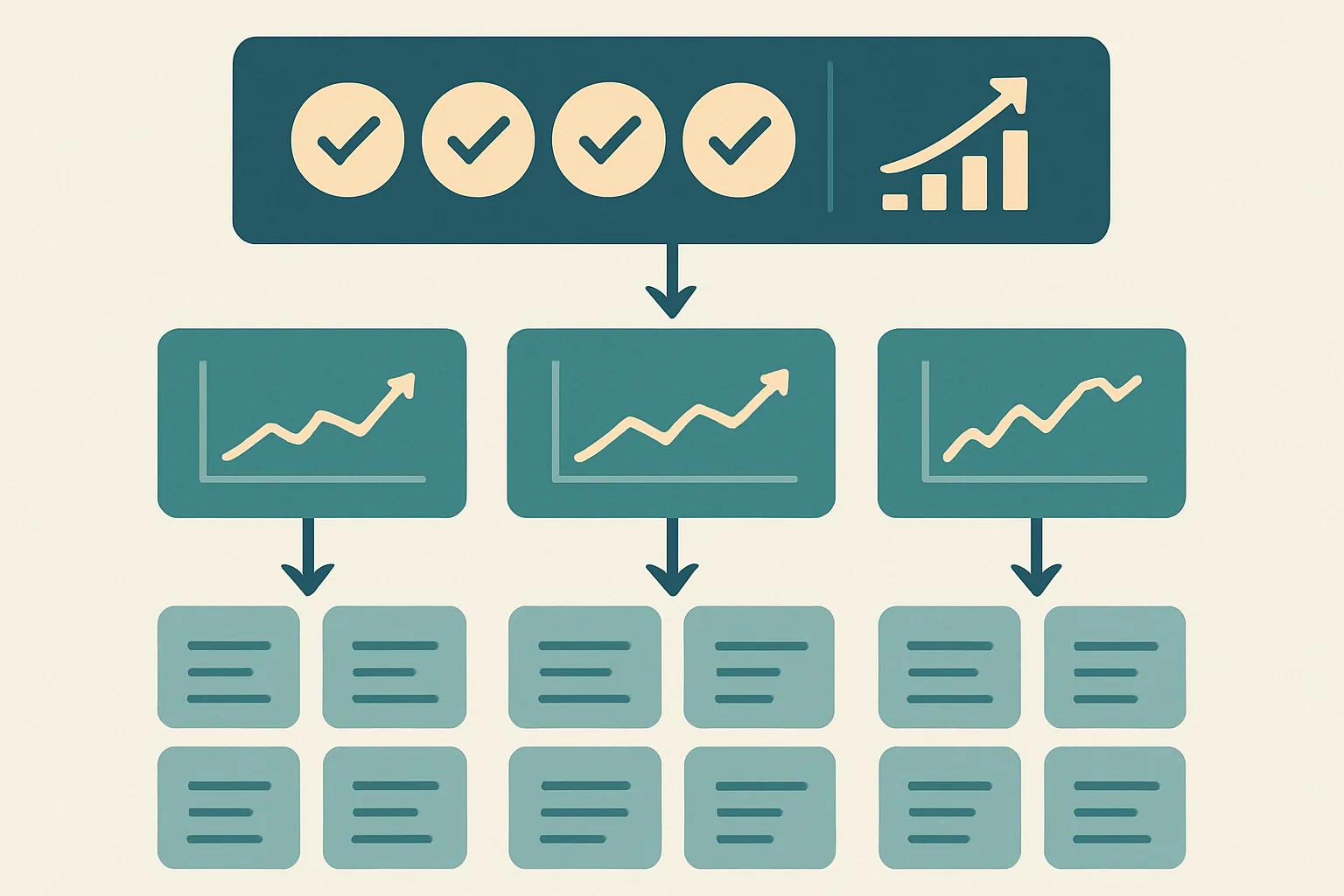
A complete marketing measurement framework has four layers:
Layer 1: Business Objectives
Start with what the business is trying to achieve in the measurement period. These are executive-level goals:
- Grow revenue by 30% YoY
- Reduce customer acquisition cost by 15%
- Increase customer retention rate from 70% to 80%
- Enter a new market segment
Marketing should be accountable to these — not isolated from business outcomes in its own metrics bubble.
Layer 2: Marketing Goals
Marketing's specific contribution to each business objective:
- Business goal: Grow revenue 30% → Marketing goal: Generate 40% more marketing-qualified leads (accounting for sales team capacity constraints)
- Business goal: Reduce CAC 15% → Marketing goal: Improve conversion rate by 10% AND reduce average CPC by 8%
Layer 3: KPIs
The specific metrics that measure progress toward marketing goals. Each marketing goal should have 1–3 KPIs. These are the numbers reviewed weekly/monthly.
Layer 4: Diagnostics
Supporting metrics that explain why KPIs are moving (or not). Not reviewed as performance indicators — used to diagnose when KPIs deviate from target.
Example: KPI = CAC. If CAC rises, diagnostic metrics explain why: CPM (did ad costs rise?), CTR (did ads perform worse?), landing page conversion rate (did the site degrade?), close rate (did lead quality fall?).
Building the Framework Document
Create a simple document (spreadsheet works well) with columns:
- Business Objective → Marketing Goal → KPI → Target → Current → Status (RAG: Red/Amber/Green)
Populate this at the start of each quarter with targets. Review monthly. The document becomes the single source of truth for marketing performance conversations.
Connecting the Framework to Data
Each KPI needs a defined data source and calculation method:
- Revenue from marketing: GA4 conversion value by source/medium
- Leads generated: GA4 form_submit event count
- CAC: Marketing spend (from ad platforms) / New customers (from CRM)
- LTV: Average order value × Purchase frequency × Customer lifespan (from order database)
Where data comes from multiple sources, document the exact calculation to ensure consistent measurement across reporting periods. Inconsistent KPI calculation makes trend analysis meaningless.
Governance: Who Owns What
Every KPI needs an owner — someone accountable for the number and empowered to take action when it deviates:
- CAC: Marketing director (owns spend allocation decisions)
- Organic lead volume: SEO/content owner
- Paid conversion rate: Performance marketing manager
- Email revenue: Email marketing manager
Without ownership, KPI deviation produces discussion rather than action.
Our marketing analytics consulting team builds measurement frameworks for clients across industries. We connect GA4, ad platforms, and CRM data into a unified Looker Studio measurement dashboard. Contact us to build your measurement framework.
Need expert tracking setup?
Our Google Tag Manager experts have delivered 500+ tracking setups with a 98% success rate.
Get a Free Consultation →