The Problem the Data Layer Solves
Without a data layer, Google Tag Manager can only read information that is already in the page's HTML or JavaScript variables — page titles, URLs, values from visible DOM elements. This is fragile: it relies on your website's HTML structure not changing, and it cannot access server-side information (order IDs, revenue, product data) that is not explicitly rendered in the page.
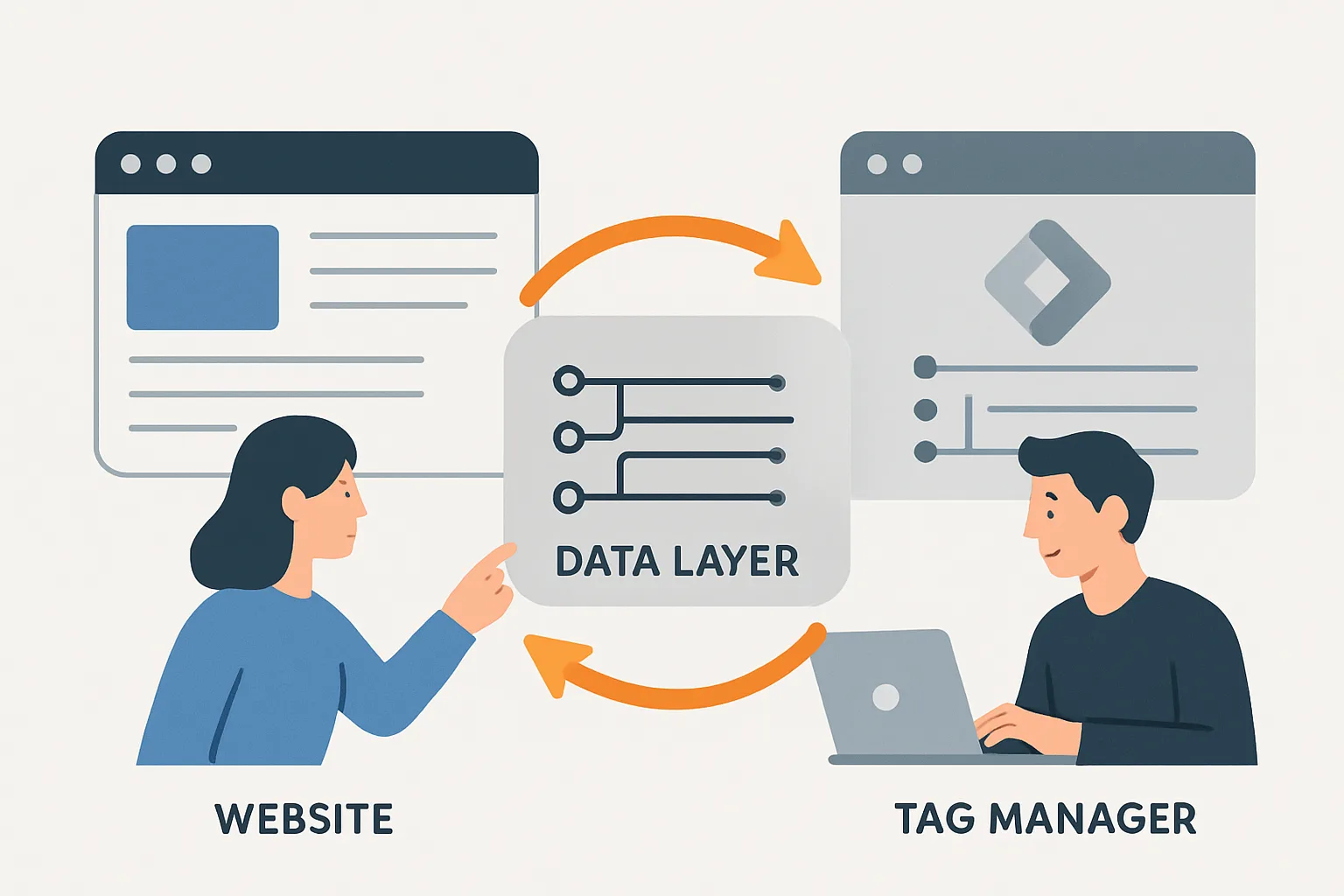
The data layer solves this by providing a structured, predictable JavaScript object where your website can publish information specifically for GTM to consume. Instead of GTM scraping the DOM, your development team writes code that pushes structured data to the data layer — creating a clean separation between data collection (developer responsibility) and tag configuration (analyst responsibility).
What the Data Layer Is
The data layer is a JavaScript array initialised before GTM loads:
<script>
window.dataLayer = window.dataLayer || [];
</script>
// Then the GTM container snippet follows
It works as a queue of objects. When something happens on the page, your code pushes an object to this array:
window.dataLayer.push({
  'event': 'purchase',
  'transactionId': 'ORDER-789',
  'transactionTotal': 149.99,
  'transactionCurrency': 'GBP'
});
GTM listens to this array. Every time a new object is pushed, GTM reads it, extracts variables from it, and fires any tags whose triggers match the event name.
The Three Roles the Data Layer Plays
- Event bus: pushes trigger signals to GTM (e.g. 'event': 'purchase' triggers a purchase tag)
- Data store: holds contextual data that tags can read (transactionId, userId, product details)
- Communication bridge: decouples analytics configuration from website code — developers push to the data layer; analysts configure GTM without touching site code
Data Layer vs No Data Layer
Without a data layer: GTM reads from DOM (fragile, dependent on HTML structure, breaks on design changes). Developers must be involved every time an analyst needs a new data point. Configuration is tightly coupled to the site's implementation.
With a data layer: GTM reads structured data from a stable API. Analysts can reconfigure tags without touching site code. Developers push data once; analysts can use it in multiple tags and platforms.
Summary
The GTM data layer is a JavaScript array that acts as a structured communication channel between your website and GTM. Your developers push events and data to it; GTM reads from it to fire tags and extract variable values. The data layer makes analytics implementations more robust, maintainable, and independent from HTML structure changes.
See our GTM Data Layer Implementation service for implementation.
Need a data layer implemented? Contact Adslytics.
Need expert tracking setup?
Our Google Tag Manager experts have delivered 500+ tracking setups with a 98% success rate.
Get a Free Consultation →