Three Infrastructure Decisions. Which One Comes First?
As privacy regulations tighten and third-party cookies fade, businesses face a cascade of data infrastructure decisions: Should we invest in a proper GA4 setup? Do we need server-side tracking? Is it time for a Customer Data Platform (CDP)? And -- critically -- which one first?
These aren't small investments. Done in the wrong order, they compound each other's limitations. Done in the right order, each one amplifies the next. This post gives you a decision tree for figuring out where to focus.
First, Understand What Each Layer Does
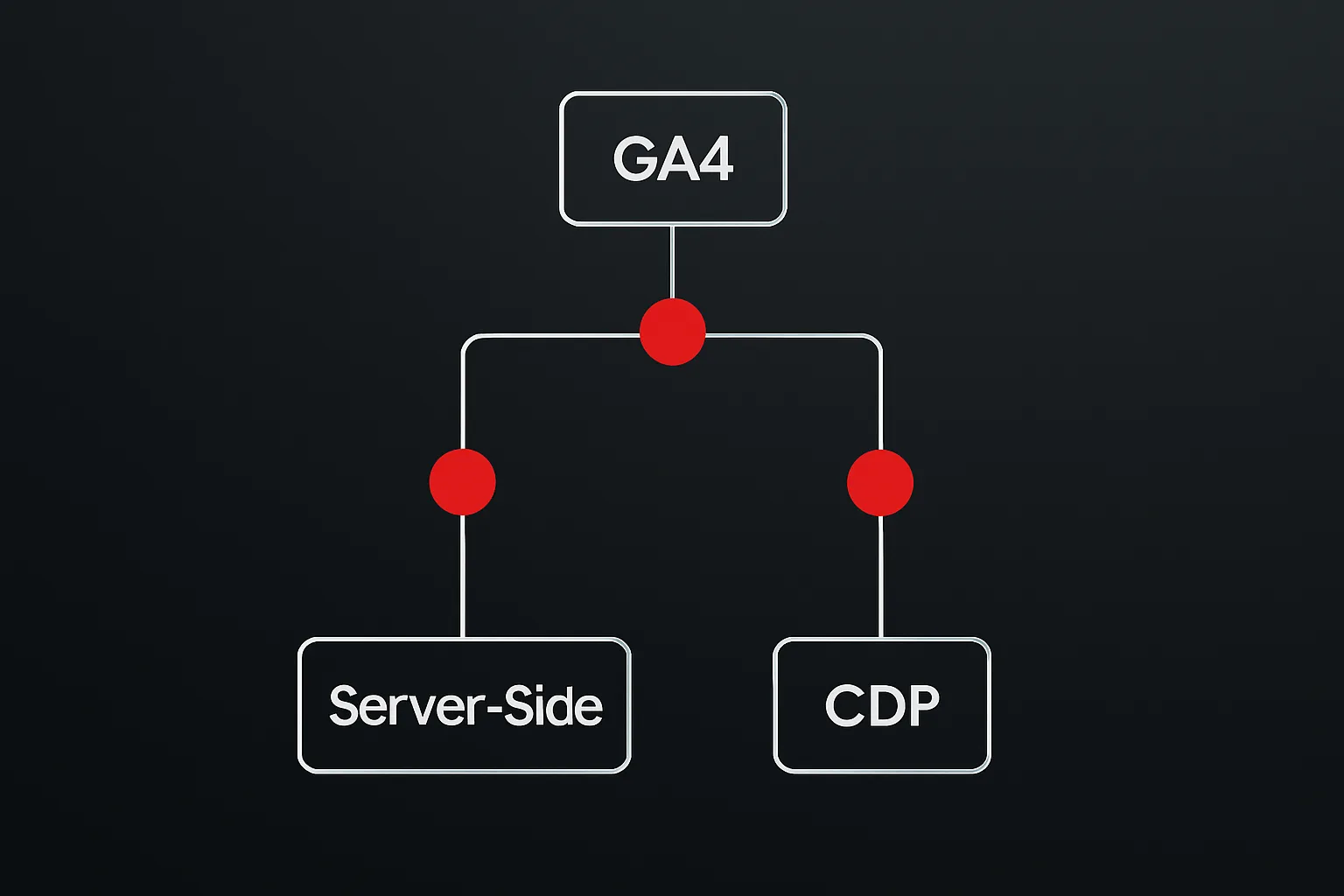
GA4 (Google Analytics 4): The analytics platform where you observe user behavior, measure conversions, and report on marketing performance. GA4 is primarily a reporting tool, not a data warehouse. It's where you answer questions about what users are doing on your site.
Server-Side Tracking (server-side GTM): Moving tag execution from the user's browser to your own server. This reduces the impact of ad blockers, improves data completeness, allows for data enrichment before sending to platforms, and keeps user data from flowing directly to third-party vendors through the browser.
CDP (Customer Data Platform): A unified database that collects customer data from all touchpoints (website, app, CRM, email, paid media, offline), resolves identities across them, and provides a single customer profile that can be activated across channels.
These three layers serve different purposes. GA4 is for observing. Server-side tracking is for collecting more accurately. A CDP is for unifying and activating.
The Decision Tree
Start here: Is your GA4 set up correctly?
If no -- your GA4 configuration is missing key events, your conversion tracking is inaccurate, or you haven't validated your data quality: Start with GA4. Everything else depends on having accurate, reliable baseline measurement. A server-side setup that sends bad data to GA4 more accurately is still sending bad data. A CDP built on top of unconfigured GA4 events captures incomplete customer journeys.
If yes -- your GA4 is well-configured, your conversions track correctly, and you trust your data: Continue down the tree.
Path A: We're losing conversion data to ad blockers and iOS restrictions, and our Meta/Google ad performance is suffering.
Invest in Server-Side Tracking first. This is the most common reason to go server-side. If you're spending more than ,000/month on paid ads and you're in a market with high ad blocker usage, browser-side tracking alone is likely costing you 20-40% of your conversion visibility. Server-side GTM with CAPI integration recovers this data and improves your Smart Bidding signals.
Path B: Our customer data is scattered across a dozen tools and we can't get a complete picture of any customer's journey.
Invest in a CDP first -- but only if you have the data volume and team to justify it. A CDP makes sense when you have meaningful scale across multiple channels, a use case that genuinely requires cross-channel identity resolution, and a team that can operationalize the unified data. For most businesses under ARR, a CDP is premature.
Path C: Our ad tracking is working fine, we just want better privacy compliance and data control.
Server-side tracking plus Consent Mode v2 is the right combination. This gives you data control, better compliance architecture, and improved performance under consent restrictions.
The Sequencing That Works for Most Businesses
For the majority of growth-stage companies we work with, the right sequence is:
- Phase 1: Properly configured GA4 with correct conversion events, Enhanced Conversions for Google Ads, and Facebook CAPI for Meta. This foundation should be in place for 3-6 months before considering the next phase.
- Phase 2: Server-side GTM setup if ad spend justifies it, with consent infrastructure if targeting European users.
- Phase 3: CDP evaluation when you have multiple meaningful data sources, a team dedicated to data operations, and specific activation use cases.
The Honest Truth About CDPs
CDPs are frequently oversold. Vendors present them as the solution to all data fragmentation problems. In practice, they require significant implementation investment, ongoing data engineering, and organizational commitment to actually drive value from. We regularly talk businesses out of premature CDP investments and back to fundamentals.
Get GA4 right first. Get server-side right if it's relevant to your scale. Then, when you've extracted maximum value from those layers, evaluate whether a CDP fills a gap that no simpler solution can.
Need expert tracking setup?
Our Google Tag Manager experts have delivered 500+ tracking setups with a 98% success rate.
Get a Free Consultation →